The office is back. The next challenge is designing office time around the work that actually gets done there.
23 July 2026
Guide
23 July 2026
Companies got people back to the office. Now they must make it matter.
Categories:
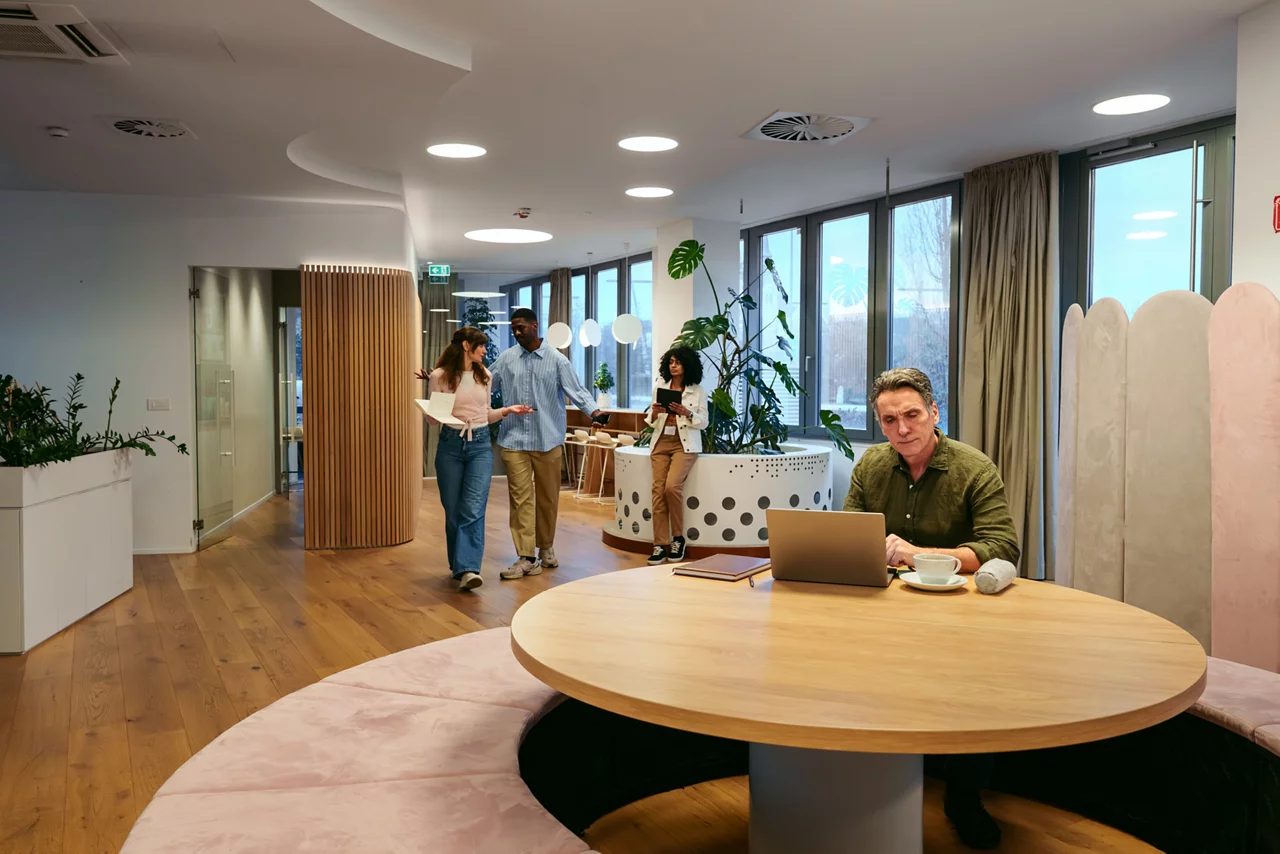
A slew of return-to-office mandates in recent years have largely succeeded in their goal: 70% of employees globally work in the office three to five days a week, according to our research.
However, many executives aren’t cueing the confetti. Instead, they’re finding that presence doesn’t equal progress. People may be spending more time in the office, but that doesn’t mean they are more productive and engaged. Now, the pressure is on to make sure office time creates measurable value: better focus, stronger collaboration, deeper engagement and a clear impact on business performance.
That’s a fair question for any CFO who just signed off on the cost of getting people back: why spend again? Because that first investment is only paying off partially. You’re covering the full cost of the office — space, services, badge systems, enforcement — while getting a fraction of the productivity back, since half of that time is spent doing work the space wasn’t designed for.
Office utilization is certainly rising, reaching 56% in mid-2026 against a global target of 74%. This 18-percentage point gap is the narrowest since JLL began tracking office usage in our annual Global Occupancy Planning Benchmark Report. But Gallup’s most recent Global Workplace report shows only 20% if employees reporting they were engaged while at work. The same research shows that disengagement at work costs the global economy $10 trillion annually.
This data shows the real question isn’t whether to invest in the workplace again. It’s whether the next dollar goes toward enforcing attendance or toward making the space people are already required to use actually work for them.
The rewards of getting it right are vast. The organizations that fail to deliver a better workplace experience risk employee frustration, poor space utilization, weakened trust and underperformance on major capital investments.
If you suspect that your workplace isn’t helping your employees do their best work, the first step is to understand how the definition of great workplaces has shifted over the past few years, so you can identify opportunities to deliver what your people need to thrive.
The new blueprint for quality workplaces
Employees are working in the office more than they were five years ago, and workplace design has a big influence on how likely they are to believe that their office is worth the commute.
According to our Workforce Preference Barometer, employees who view their office attendance policies positively tend to work in environments that make a genuine effort to balance business needs with employee wellbeing. They’re more satisfied with things like the design and spatial layout of the office, wellbeing services, social infrastructure and mobility support.
Meanwhile, employees who dislike their organization’s hybrid policies often lack these conditions. It’s no surprise, but still not something many corporate leaders identify and appreciate: the quality of the office experience is essential to proving its value.
But here’s the crux: some companies are trying to recreate the ideal work environment of 2019, and that’s not what drives success today.
“Over the past few years, the definition of a ‘quality workplace’ has changed dramatically,” says Peter Miscovich, Global Future of Work Leader at JLL. “Before the pandemic, a high-quality office might have meant a well-located building, attractive finishes, good coffee, collaborative spaces and a strong brand presence. Those things still matter, but they are no longer sufficient.”
Miscovich reveals that employees now evaluate the workplace through a more practical lens:
- Can I do my best work here?
- Does it support my health and well-being?
- Does it give me access to colleagues, leaders, clients, tools and experiences I can’t easily replicate at home?
- Does it make my day better and easier — or harder?
Additionally, “quality” now means creating spaces where all employees feel they belong and can participate fully. This applies to the full spectrum of workers: new hires seeking connection, managers leading distributed teams, caregivers managing complex schedules, neurodiverse employees needing lower-stimulation environments, and teams navigating both in-person and virtual collaboration.
Ever-evolving workplace standards
Looking ahead, Miscovich believes the hallmarks of a quality workplace will continue to shift. Workplaces will become more adaptive so spaces can flex based on team rhythms, occupancy patterns, project cycles and changing business needs. Essential technologies will become more invisible as AI-enabled tools are seamlessly integrated into the overall experience.
The workplace will also emerge as a stronger cultural platform to reinforce an organization’s purpose and values.
And perhaps most profoundly, a quality workplace will be measured much more by the outcomes they foster.
“The question will not be, ‘How attractive is the office design?’ but ‘Does this workplace improve productivity, engagement, innovation, learning, retention and business impact?’” says Miscovich.
Underpinning it all will be data. Organizations will combine real estate, people and business data to understand what’s working and what’s not, so they can continue to remove friction and improve the quality of the experience.
How to know if your workplace is working for your business
As employee expectations evolve, we’re seeing executives at companies of all sizes rethink how they measure real estate success. Cost, square footage, occupancy and utilization still matter, but they don’t tell you how the office is driving value.
The most advanced companies today combine badge, sensor, reservation and space data with qualitative insights to understand not just whether people are coming in, but whether the workplace is helping them do great work.
Integrating data to create a more complete picture of workplace performance helps companies decide where to invest capital, which leases to renew or exit, how to redesign space, which amenities matter and how to solve other practical issues. Measurement also enables continuous improvement, enabling companies to adjust their workplaces quarterly or even monthly based on the latest feedback.
Given the importance of data on decision-making, corporate real estate teams are feeling more pressure from their C-suites to measure the right metrics. Executives want to understand the impact of the workplace on business outcomes, but skills gaps in AI, analytics and emerging technologies are standing in the way.
“Our latest Future of Work survey found that 46% of C-suite leaders rank employee productivity as a key performance indicator for the real estate team, and 34% want to understand how real estate is supporting innovation. However, many organizations lack the expertise and measurement tools to track these metrics,” said Dan Rooney, Managing Director, Consulting, JLL.
A strong real estate partner can help close the measurement gap – bringing benchmark data from thousands of workplaces, the tools to track the right metrics and the experience to turn raw data into decisions a C-suite can act on.
We’ve seen what that looks like in practice: across our own work, we’ve benchmarked performance for 500+ corporate real estate portfolios and helped occupier clients identify more than $3 billion in cost savings — the kind of pattern recognition that only comes from working across that many workplaces.
The new indicators of workplace performance
Leading organizations evaluate workplace strategy through the lenses of employee sentiment, cost and innovation. Then, they bring those perspectives together with real estate, financial and HR data to get a full picture of how the workplace supports business outcomes.
These three lenses map directly onto how your leadership team already measures the business, even if no one has labeled it “workplace performance” before. A CFO reads this through cost per seat and portfolio efficiency — the same numbers used to model any other capital decision. A CHRO reads it through retention, engagement scores and time-to-fill, since a workplace that undermines focus or belonging shows up first in attrition.
And a CEO reads the innovation lens as a competitive signal: how fast the organization solves problems and gets new work to market. None of these are new metrics. What’s new is that workplace performance now shows up directly inside the ones your leadership team already reports on.
Building a workplace that supports employees
If your workplace strategy isn’t driving the desired outcomes, it’s time to take a closer look at whether your offices are designed to help your people do their best work.
One common mistake is not providing the right type of space for how employees spend their days. Our Human Experience research shows 51% of office time is now spent on focused work. However, many office designs still prioritize collaboration.
As companies make real estate investment decisions, 63% are putting emphasis on collective spaces, while just 37% are prioritizing individual desks, according to JLL’s Future of Work survey.
Given this disconnect, it should come as no surprise that, according to the same survey, 63% of employees believe their home is better suited for focused work. That should be a wake-up call for executives, says Miscovich.
“If companies want employees to get the most out of the office, they must design for the work employees need to do. Employees need spaces to connect, co-create, learn, mentor and build relationships, but they also need places to think, analyze, write, design, code, prepare, review and make decisions,” he says.
How leading companies revamped their offices to help employees thrive
Across industries and space types, we’ve worked alongside companies that are getting it right by nailing environments that fit the specific needs of workers. (And by the way, it’s no coincidence these organizations are also strengthening their culture and hitting their innovation goals.)
Heads-down space for focused work
A global technology company discovered that employees were avoiding the office on days when they needed to complete complex engineering or documentation work. The real estate team encouraged attendance during these workdays by adding libraries, enclosed focus rooms, acoustically protected neighborhoods and clearer etiquette.
This approach aligned with JLL's workplace research showing that quiet space for deep focus ranks among the top enablers of exceptional workplace experience. The strategy included sound masking, designated quiet days with limited internal meetings and adjacent rooms for private calls. Employees reported being happier and more productive, demonstrating how the office can transform from a mandated workspace location to a desirable destination.
Balancing collaboration and concentration
Consultants at a professional services organization needed the office for apprenticeship, coaching, client preparation and team problem-solving, but they also needed quiet space between meetings to synthesize information and produce high-quality deliverables. The firm created a more balanced space with an intentional mix of team rooms, focus pods, reservable quiet areas and heads-down work zones.
Recognizing that employees naturally move between thinking, coordinating, and recharging throughout their workday., individuals no longer had to choose between collaboration and concentration as they moved through their days. This strengthened the in-office experience and addressed the reality that when output depends on judgment rather than presence, workplace design must respect natural work rhythms.
Enhanced privacy for risk management
In a financial services organization where privacy and concentration were particularly important, employees were frustrated by noise distractions and a lack of appropriate spaces for confidential analysis and decision-making. By investing in better acoustic design, enclosed work points, quiet floors and clearer space-use protocols, the organization improved employee confidence in the workplace and increased the perceived usefulness of the office.
Analyzing data from occupancy sensors, the team identified underutilized spaces that needed improvements. After updating one collaboration space, average utilization increased from less than 5% to above 40%, peaking at 90% on the busiest days.
10 lessons from leading workplaces
Looking at leading companies for inspiration, we see 10 common threads in how they design their offices to make the workday easier and more enjoyable.
- Neighborhood-based planning with activity zones: Organizing an office with dedicated areas for each team or project allows spaces to be designed with unique features for each group’s work, such as acoustic pods, war rooms, whiteboard walls and collaboration tables.
- Hybrid-first collaboration studios: Our research shows employees spend 20% of office time on virtual collaboration. High-fidelity rooms with eye-level cameras, directional mics and shared digital whiteboards make it easier to work with people in other locations.
- Library-level focus sanctuaries: Clearly labeled quiet floors or zones give employees the distraction-free space they need for deep focus work — especially when companies enforce “library” etiquette such as no calls or conversation.
- “Social gravity” spaces: Leading companies engineer these spaces, which are designed to naturally pull people together into each other’s social orbits. Centrally located, hospitality-grade lounges, cafés and team commons create space for serendipitous collisions that enhance belonging and information sharing.
- Onsite learning labs and mentorship hubs: An office accelerates talent development by offering dedicated learning spaces, such as mini classrooms, VR practice pods and mentorship lounges.
- Team rituals enabled by space and scheduling: Predictable, high-value rituals such as “Demo Thursdays” or monthly “Solve-a-thons” give employees an extra reason to make the commute.
- Wellness-integrated design: When holistic wellbeing is embedded in the floor plan, employees leave the office feeling better than when they arrived — making them more enthusiastic about returning. Examples include walking loops that connect departments, meditation rooms for recharge breaks and superior air quality systems that sustain energy throughout the day.
- Frictionless arrival to work: Simple design features and policy decisions, such as license-plate recognition in the parking garage and well-placed lockers, make it easier and more pleasant to jump into the workday.
- Flex desking with certainty: When supported with the right technology and established social norms, hybrid booking practices can make it easier for employees to connect with the people they came in to see.
- Company story showcase spaces: Branded, immersive areas highlighting customer impact, product roadmaps and wins connect daily tasks to the mission.
Investing in leadership and change management for the win
A well-designed office can only do so much if employees don’t understand the purpose of a new space or if they see leaders breaking policies and etiquette rules. They need guidance, norms, rituals, team agreements, manager enablement and ongoing feedback loops to translate workplace intent into daily behavior.
Change management programs help employees understand why the workplace is changing, how to use space effectively and what behaviors will make the new environment successful. However, our research shows the number of companies investing in change management programs declined from 40% in 2025 to 31% in 2026 — indicating a critical gap.
“Too often, companies underinvest in the human adoption layer that enables workplace investments to create value,” says Miscovich. “Organizations can’t simply create better spaces to win the future of work; they must help people use those spaces better.”
A successful change management program goes beyond announcements at the end of an office redesign, functioning as a support system that help employees make sense of why things are changing. It links workplace changes to business strategy, explaining how the workplace supports innovation, mentoring, productivity, customer outcomes and culture.
Additionally, leading organizations equip managers for successful change. If managers do not know how to lead hybrid teams, create inclusive meeting practices and model effective office use, the workplace strategy will stall. Conversely, when executives and managers set good examples, they shape an environment where everyone can do their best work, making manager enablement one of the highest-return investments in workplace change.
Commit to creating workplaces that work
The real test of workplace strategy isn’t whether you can get employees back to the office, but whether they’re doing better work once they’re there. The workplace drives business performance when it reliably supports collaboration, learning, belonging and focus.
Ready for a workplace that helps your employees do their best work?
We help companies diagnose what isn’t working in their offices and then design better experiences that support business objectives. Contact JLL Consulting to schedule a workplace performance diagnostic and see exactly where your office is working for your people – and where it’s working against them.
To learn more, visit JLL’s Consulting Services page.