How vibrancy mapping and tech integration are reshaping office design
30 September 2025
Guide
30 September 2025
Designing for vibrancy
Categories:
Authors
Susan Chang
This Q&A with Susan Chang, Senior Vice President, JLL Workplace Design Advisory, was originally published on workdesign.com.
WDM: Susan, we’d like to get your take on the future of work. The AVI-SPL client story is a great example of a workplace design that incorporates technology as always accessible but never dominant. What lessons from that project could designers carry into their own work?
Susan Chang: The AVI-SPL project exemplifies technology that enhances human connection rather than creating barriers to it. The key lesson for designers is to start with behavioral outcomes, not technological capabilities. We designed spaces where collaboration tools emerged naturally from the architecture itself.
The takeaway is this: successful workplace technology should feel like magic, not machinery.
When someone walks into a meeting room and the space intuitively responds to their needs without complex interfaces or learning curves, we’ve achieved true integration.
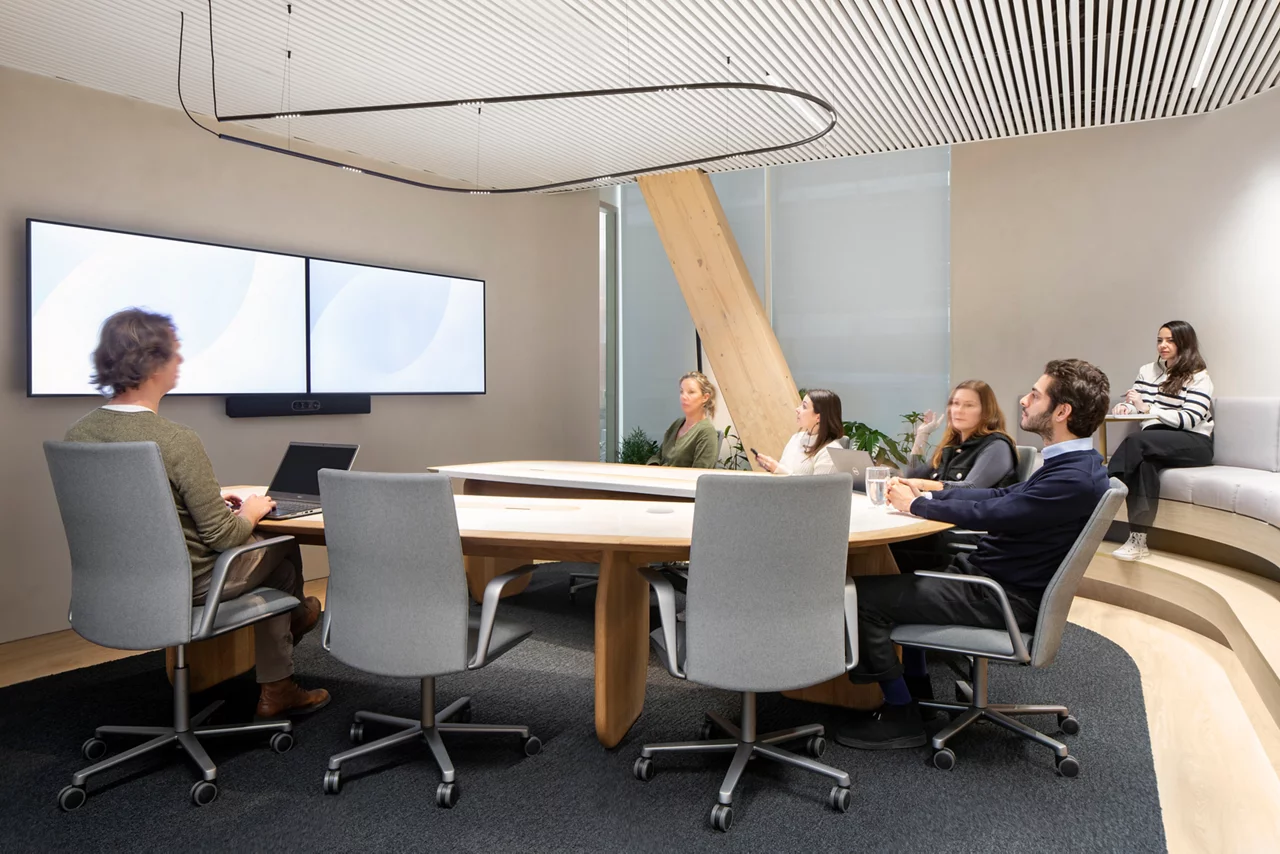
Modern offices have fresh, tech-enabled meeting spaces that allow teams different ways of connecting and engaging with in person and virtual participants. JLL Brussels, Image Hannelore Veelaert.
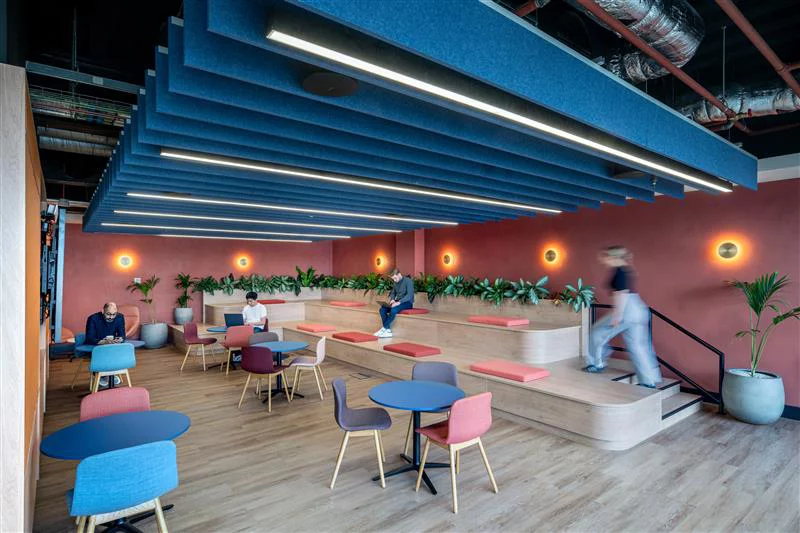
The flexible space suits multiple purposes: sometimes a work café, sometimes a host for town hall meetings or client presentations. It features a palette of bright colors carried through the acoustic panels on the ceiling, walls and furniture to create a cozy, energizing community space. JLL Birmingham UK office, Image: Jonathan Banks.
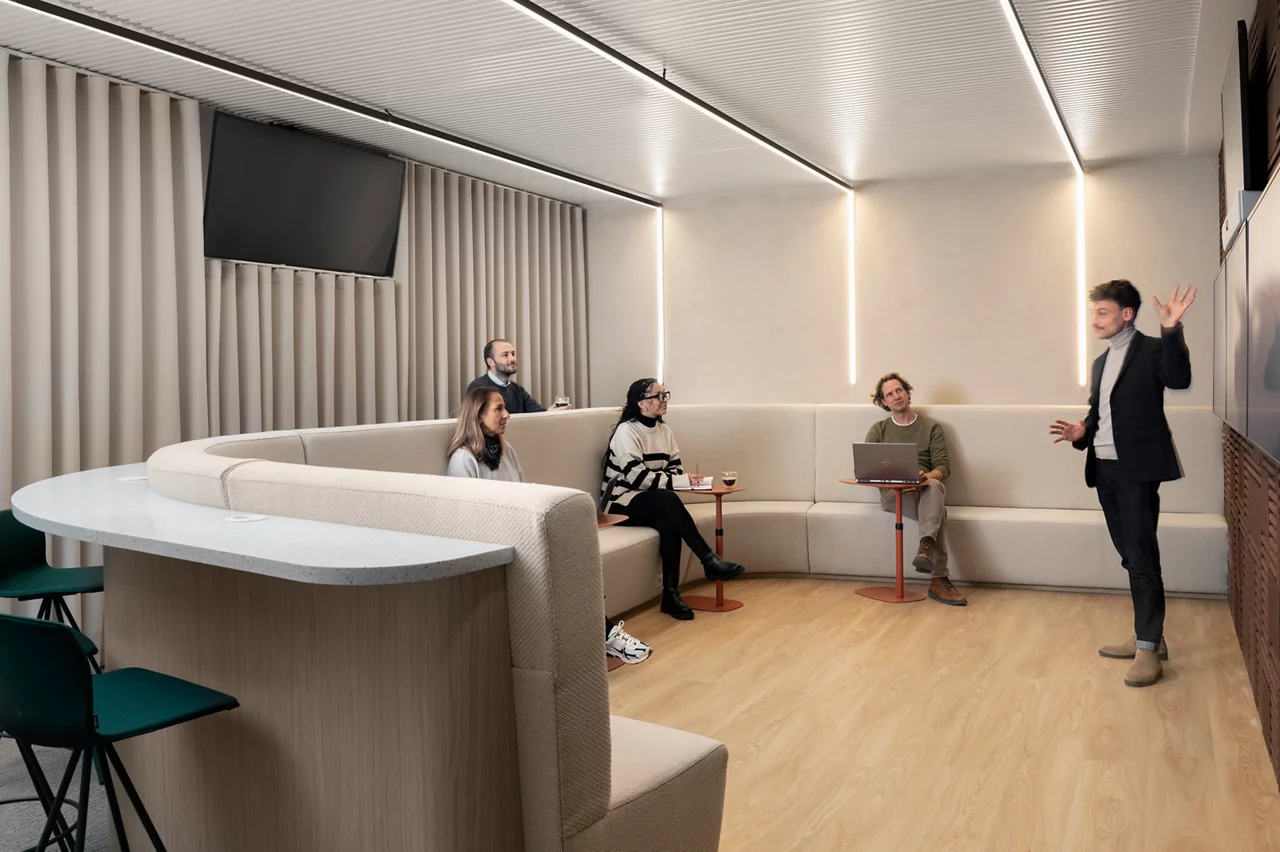
Virtual meetings and use of digital content in presentations have changed the shape and furniture placement in meeting rooms, empowering different ways of connecting and engaging, in-person and virtually. JLL Brussels, Image Hannelore Veelaert.
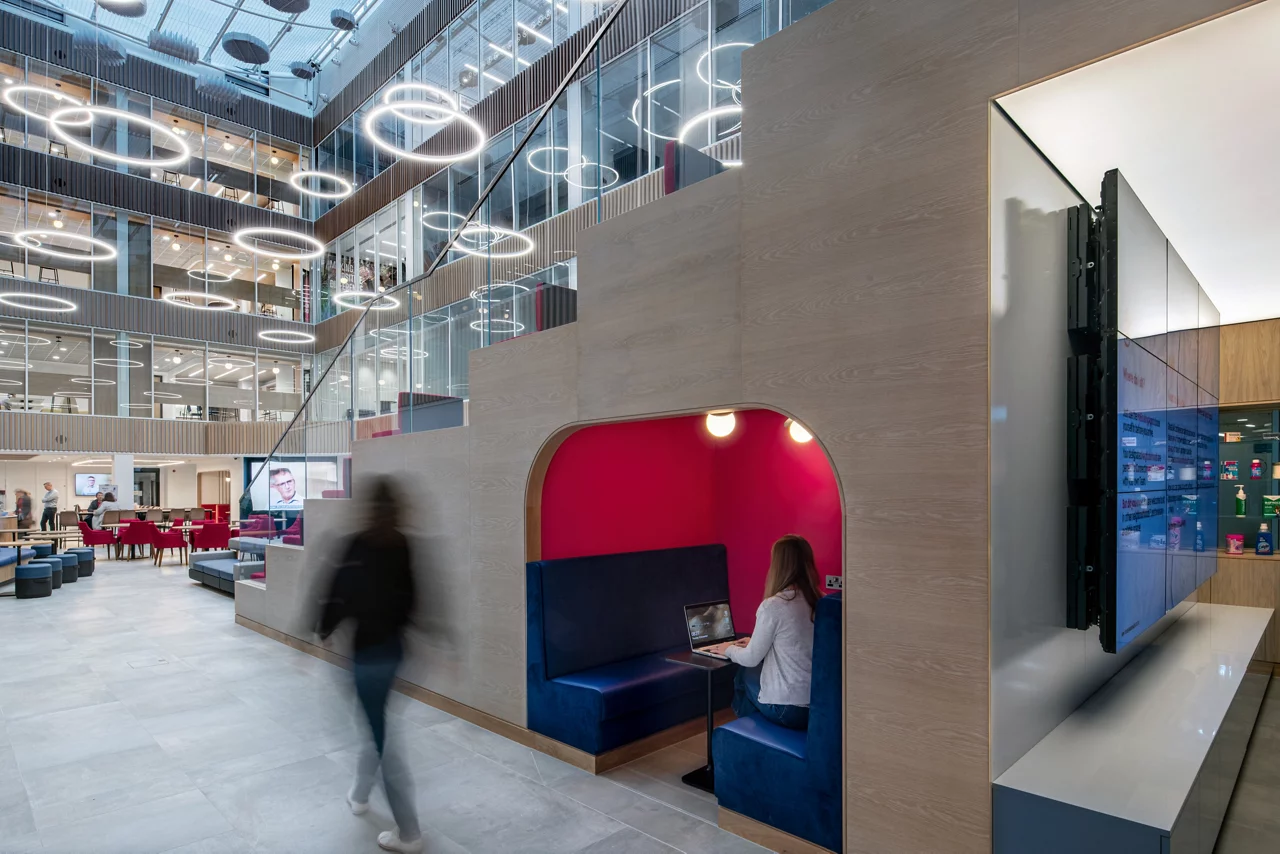
Hidden away under stepped bench seating for presentations to larger teams, Reckitt embraces space efficiency with individual work booths. Reckitt London office, Image Jonathan Banks.
What design strategies can we use to create an inclusive environment that attracts diverse talent and improves employee engagement?
Inclusive design is fundamentally about understanding and designing for vibrancy profiles – recognizing that different work requires different energy levels, and different teams naturally operate at varying intensities. High-vibrancy spaces support dynamic collaboration with open layouts, stimulating colors, and technology that facilitates rapid information sharing, while low-vibrancy spaces emphasize calm palettes, controlled acoustics, and minimal distractions to support deep focus and contemplative work.
The vital aspect is matching spatial energy to work energy. Our design process now includes vibrancy mapping – analyzing teams’ work patterns and collaboration styles, then creating corresponding spatial experiences. A high-vibrancy marketing team might feel stifled in a library-quiet environment, while a research group could find an open collaboration space counterproductive.
When spatial vibrancy aligns with team vibrancy, we see dramatically improved engagement, productivity, and talent retention across all work functions. This vibrancy-first approach has become our signature methodology, and we’re seeing higher space utilization rates when spatial vibrancy aligns with team vibrancy compared to traditional “one-size-fits-all” designs.
What design elements should we consider to future-proof our space for evolving work practices and technologies?
Future-proofing isn’t about predicting the next gadget – it’s about building adaptive capacity into the physical environment. We focus on three core principles: robust infrastructure, modular systems and human-centered flexibility.
This means designing power and data pathways that can accommodate unknown future needs, creating furniture systems that can be reconfigured rapidly, and most importantly, building spaces that can support evolving work patterns and attract and retain high-performing talent.
The offices that thrive in 2030 won’t be the ones with the most advanced technology today – they’ll be the ones that can adapt to whatever comes next. This matters because workplace investment cycles are long, but business needs change rapidly.
Integrating sophisticated tech into architectural elements and furniture can be tricky, but “shy tech” is considered the latest luxury. What are the key challenges you encounter, when balancing functionality, comfort, and aesthetics to create united “phygital” (physical + digital) spaces?
The biggest challenge is the fear that visible tech will quickly look dated or create user friction. Our approach is to embed intelligence in beautiful, timeless elements. Think: conference tables with hidden connectivity, walls that double as display surfaces or lighting that provides both ambiance and data feedback.
Collaboration between industrial designers, technologists and behavioral scientists from day one is the key to making this happen. We’re not just hiding wires – we’re reimagining how digital and physical experiences can feel unified. When technology feels like a natural extension of the architecture rather than an addition to it, we’ve achieved that luxury “shy tech” experience.
The Fit-Out Cost Guide research suggests that occupiers are investing more in workplace updates. How is this shaping design priorities (and budgets) in 2025 and early 2026?
The research confirms what we’re seeing globally – organizations are moving from cost-cutting to strategic investment in workplace experience. This shift is driving three major priorities: employee retention through quality workplace experiences, productivity optimization through smart space utilization and brand differentiation through innovative design.
Budgets are increasingly allocated toward experiential elements – advanced air quality systems, biophilic design and technology that learns and adapts to user preferences. We’re also seeing investment in advanced data analytics capabilities that help organizations understand how spaces actually perform, not just how they look.
Beyond aesthetics, how do you measure whether the workplace is truly enhancing user experience? Are there metrics or indicators that signal success?
True success is measured in behavioral change and achieved business outcomes. Data-driven, AI-augmented design decisions lead to more effective workplace evolutions than intuition and best practice expertise alone.
For example, on behalf of clients, we can track utilization patterns through anonymized sensor data, measure collaboration frequency and quality, and monitor employee satisfaction through pulse surveys.
But the most telling indicator is what I call “gravitational pull”: do people choose to come to the office when they don’t have to?
We also measure adaptability – how quickly spaces can be reconfigured for new needs and technology adoption rates.
The proof is in the data. When people are using the tools we’ve provided and the spaces are being activated as intended, we know we’ve created something meaningful and effective.
Finally, what advice would you give architects and designers who want to incorporate subtle, elegant and effective technology into their next projects? Any guiding principles, best practices or practical tips?
Start by understanding not just how people work, but the vibrancy profiles of different teams and work functions. Conduct vibrancy assessments early in programming to identify which groups operate at high intensity versus those requiring calm focus. This becomes your spatial DNA for the entire project.
Practically, I recommend three approaches: First, map team vibrancy profiles before designing any space layouts – this determines your acoustic, lighting and technology integration strategies. Second, create transitional zones between high and low vibrancy areas to prevent energy conflicts. And third, plan for team evolution – spaces should be able to shift vibrancy levels as organizations and work patterns change.
The most elegant solutions feel effortless because they’re energetically aligned with their users. When spatial vibrancy matches team vibrancy, technology integration becomes intuitive, aesthetic choices feel natural and human behavior flows seamlessly.
This vibrancy-first approach transforms workplace design from guesswork into strategic, evidence-based decision-making.
Really, it all comes back to integrating technology and data throughout your project, making data-driven decisions to create frictionless user experiences that keep top talent engaged and productive, and delivers value for critical business outcomes.