Exploring the implications of humanoids for work and commercial real estate
04 September 2025
Insight
04 September 2025
How Humanoid Robots Could Reshape Work
Categories:
Authors
Andrew Batson
Christian Beaudoin
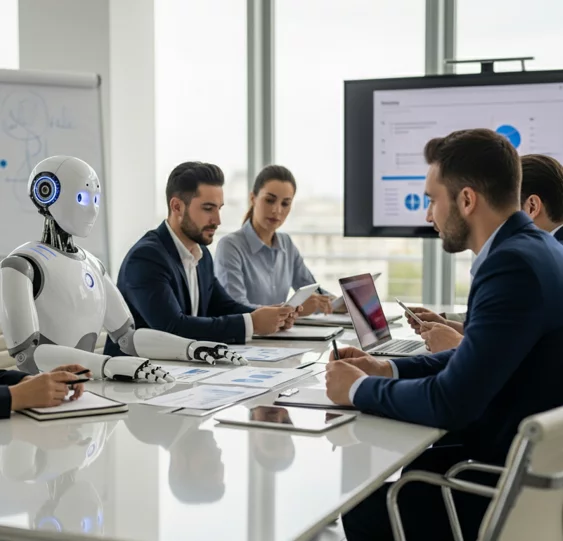
This work product was created with assistance from generative AI. Created with Adobe Stock licensed images and Adobe Firefly
Key highlights
Humanoid robots, powered by AI, are rapidly approaching commercial viability. At least five companies are set to release humanoid robots for purchase over the next two years, and several start-ups have models in development. For many organizations and households, owning a humanoid robot could be a reality by 2028.
Humanoid robots will help to alleviate the current skilled labor shortage. Without population growth or immigration, developed countries will not have enough labor for many jobs, from manufacturing to healthcare. There are millions of unfilled positions in the U.S., and robots are already starting to fill the gap.
The market for manual labor may be completely transformed by 2030. With robots able to perform tasks ranging from vehicle assembly to dishwasher emptying, up to 30% of hours currently worked across the U.S. economy could be automated by 2030. This has the potential to transform not just companies but entire cities and regions.
Space needs per human will differ from space needs per robot. The required amount of space and the management of such space will evolve considerably. Space might be measured in square feet per unit of output rather than square feet per person. Furthermore, robots will require maintenance but not cafeterias or ping-pong tables.
The new hybrid workplace: humans, AI and robots all working together
For the last five years, the term “hybrid work” has dominated the commercial real estate industry, shaping every sector from the office market to industrial and residential. Although there are many definitions of the term, hybrid work has generally referred to some combination of work conducted from a formal workplace and work conducted at home or elsewhere.
Many office workers in the post-Covid world have enjoyed hybrid schedules in which they are required (or mostly just encouraged) to be in the office on some days and then allowed to work elsewhere on other days. In the corporate environment of the United States, Fridays have become generally accepted days for doctor appointments, oil changes and other errands, while employees occasionally take calls off camera.
This definition of hybrid working has defined the office landscape from 2021 to 2025 and it has transformed companies and cities around the world, helping some while challenging others.
However, as we look forward towards 2030, there will be an entirely new force that will shape the way we work. Hybrid work will not be defined by where we work but by who (or what) we work with. The new hybrid workplace will be part human and part robot.
The next iteration of hybrid work will be defined by the proliferation of artificial intelligence (AI) and the introduction of humanoid robots. The number of AI agents deployed in the workplace is already soaring, with several sources forecasting a compound annual growth rate exceeding 45% from 2025 to 2030. Now, we are at the threshold of humanoid robots joining the physical workforce.
“Going forward, hybrid work will not be defined by where we work, but by who (or what) we work with. The new hybrid workplace will be part human and part robot.”
Humanoid robots will dramatically change how we live and work
The global market for humanoid robots is poised to grow exponentially over the next several years, with some estimates of the total market size reaching $5 trillion over the next two decades. With recent advances in both the hardware and software necessary to create working humanoid robots, the market is on the cusp of a breakthrough that will have significant impacts on how we live and work.
By 2030, everything from routine surgeries to massive construction projects will incorporate some level of humanoid robotics. Every repetitive action, and many novel actions, could be shifted from manual execution to robotic, reducing human injuries and human error.
As humanoid robots become increasingly integrated into daily life, the global workforce will need to adapt, new policies will need to be formulated and society will have to navigate the ethical and economic challenges that arise. The race to develop and deploy humanoid robots is not just about technological progress — it is about shaping the future of work and life.
Humanoids are suddenly relevant due to tech advances, declining costs and increasing demand
Within the last year, humanoid robots have captured the imagination of the public. Videos of humanoids completing everyday human tasks are trending on the internet, and by 2030, millions of robots could be interacting with society.
Why is excitement building in this moment? There is a confluence of three major factors: technological advances, declining costs and increasing demand.
Technology: Advances in AI, robotic dexterity and training ease are fast-tracking humanoid robots into the physical world, where software automation alone is less effective.
Cost: Humanoid robots are approaching cost parity with human labor, and they are poised to take on physical jobs across industries within the next five years.
Demand: Labor shortages, aging populations and reshoring efforts are creating new demand for automation. Robots can help close the gap.
Humanoids can do many of the jobs that humans don’t want to do
Some people have speculated that AI and humanoids could lead to job losses and higher levels of unemployment. Humanoids may be better suited for some types of jobs in the future, but new human jobs will be created to offset those that shift to robots. We have seen this in society decade after decade with the advent of new technologies.
The speculation mentioned above overlooks an obvious benefit that humanoids can provide. There are millions of jobs that go unfilled year after year. These are jobs that people do not want to do or there are not enough people with the right skill set.
There is a saying in the robotics industry that humanoids will provide value to society by filling jobs that are dull, dirty and dangerous. This will free up more time for humans to focus on the professional and personal activities they find more enjoyable.
The new hybrid workplace will provide humans more time for connection
There are aspects of everyone’s job that are repetitive or tedious. In many cases, this work is low-value but necessary to complete.
In the future hybrid workplace, these tasks can shift to humanoid robots, freeing up human workers to focus on higher-value activities that are stimulating and fulfilling.
As humans, we are striving for connection and meaning. The integration of humanoids into the workplace will allow humans to focus on collaboration with colleagues and relationship building with clients and stakeholders.
Humans will also have more time for critical thinking, strategy development, creativity and innovation. In the future, robots will be a valuable partner in these human-centric activities, supplying vast knowledge via their AI programs.
Humanoids have implications for all elements of commercial real estate
Humanoid robots and agentic AI will have significant implications for the provision of real estate services over the next decade.
Almost every element of commercial real estate management and operations (shown below) will experience some changes due to these technologies.
Site selection and location strategy: May shift as access to talent partially gives way to access to power.
Leasing and space needs: May change, and the measurement of area per person may become less relevant than area per output or area per unit produced.
Facility management and operations: Will change dramatically, with repetitive and dangerous tasks outsourced to robots, who can work 24/7.
The implications of humanoids for construction management
Humanoid robots are poised to significantly transform the construction industry, with implications across the entire project life cycle. Robots will soon be deployed to perform dangerous operations, including:
- Work at high altitudes or in confined spaces
- Hazardous material handling
- Structural inspections in unsafe conditions
- Demolition in unstable environments
It is important to remember that any construction project will still require significant human labor. Humanoid robots create the opportunity to augment the human workforce rather than fully replace it. And there are still questions about how humanoids will operate over long periods of time in wet conditions, dirty environments and at extreme temperatures.
Humanoids could bring significant benefits to construction projects including faster schedules, reduced costs and improved safety:
- Reduced weather-related delays for certain tasks
- Safety improvements with reductions in workplace injuries and downtime
- Faster project completion, with the potential for 24/7 construction workdays
- Shorter construction timelines reducing carrying costs
- More predictable project schedules and budgets
- Potential for lower overall construction costs
The implications of humanoids for facility management
Humanoid robots are poised to significantly transform the facility management industry in several key areas, highlighted at right.
The most successful implementations will likely be hybrid models where robots handle routine, repetitive tasks while human facility managers focus on tenant relations, strategic planning and complex problem-solving.
The key is viewing humanoid robots as tools that augment human capabilities rather than wholesale replacements.
Humanoids could positively impact facility management through cost reductions, efficiency gains, enhanced service delivery and safety
24/7 operations: Robots can perform routine tasks continuously without breaks, overtime pay or shift changes.
Safety management: Humanoids can work in unsafe environments and handle dangerous materials, improving human safety conditions.
Labor cost optimization: Robots handling repetitive tasks will allow human staff to focus on higher-value, strategic activities.
Consistent quality: Humanoids can deliver standardized cleaning protocols without human variability, ensuring consistent service delivery.
Predictive maintenance: Advanced robotic sensors can enable early detection of equipment issues, reducing costly emergency repairs.
Emergency response: Humanoids can be rapidly deployed to incidents 24/7 with real-time communication to emergency personal.
There is a bright future for those who adapt to the new hybrid workforce
For both employers and employees, the deployment of humanoid robots will bring challenges and opportunities.
For employers, looking forward, managers must begin to evaluate tasks and their ideal channels for completion. Onshore human labor now competes not only with offshore talent but with AI agents and, soon, humanoid robots.
For employees, now is the time to develop the soft skills and strategic mindset that will be needed in an era of AI-powered agents and humanoid robots.
There is a world of opportunity beyond repetitive tasks, and there is a bright future ahead for those who adapt to the evolving hybrid workforce.
More from JLL’s Future Vision program
- The future of real estateJLL’s new global research program explores the impact of economic, societal, technological and geopolitical megatrends on the future of real estate
- Quantum Real Estate: Future of Digital Infrastructure | JLLTransitioning from theory to deployment
- The climate inflection pointDeveloping climate resilience for real estate will require radical engineering, nature-based and AI-powered solutions
- Get set for the 5th Industrial RevolutionReal estate strategies for an AI-powered world
- Prepare yourself for the future of retailHybrid places, sustainable stores, shopper assistants and more
- The future of corporate real estate in the AI ageFrom Bengaluru to San Francisco. Designing workspaces for human-AI collaboration
- Space-Based Data Centers: Future of Digital Infrastructure | JLLThe forces pushing and pulling data center infrastructure above the cloud
Want to learn more?
Get in touch with our research team to find out how we can support your real estate strategy with market insights and strategic advice.