The forces pushing and pulling data center infrastructure above the cloud
09 June 2026
Insight
09 June 2026
Space-Based Data Centers: The Future of Digital Infrastructure
Categories:
Authors
Ben Hamley
Andrew Batson
Daniel Thorpe
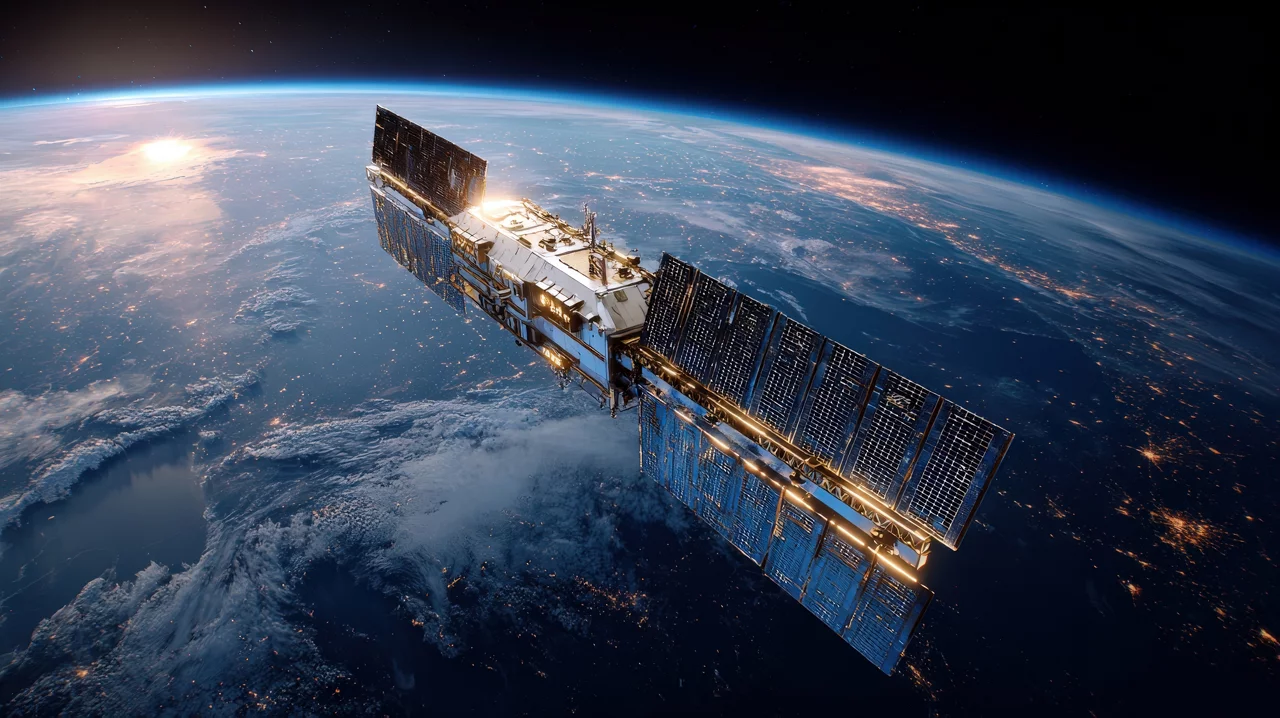
Image by Alex Volkov - stock.adobe.com. This work product was created with assistance from generative AI.
Key highlights
- Data centers in space are no longer a distant prospect - they are becoming reality.
- The feasibility of orbital data centers depends on the workloads that will dominate future demand.
- The future is not replacement, but functional specialization: orbital systems handling asynchronous, energy heavy workloads, while Earth based data centers retain dominance in real time computing.
- Key milestones and metrics to monitor give investors and data center operators an advantage in their strategic planning.
Introduction
As the world's appetite for data and artificial intelligence continues its exponential growth, the terrestrial constraints of land, power, sustainability and geopolitical security are pushing the data center industry to consider radical new horizons. At the same time, a different kind of infrastructure is being assembled above us to cater to the exponential increases in data generated ‘above the cloud’.
Once the realm of science fiction, data centers in space are becoming reality. Companies like Starcloud, Aetherflux, and even major players like SpaceX and Google are actively developing and deploying the first generation of orbital data centers and space-data infrastructure.
This is the result of two powerful forces: terrestrial constraints pushing compute beyond Earth's atmosphere, and orbital economics pulling it upward.
This JLL Future Vision article details the drivers of change and explores ‘what must be true’ for data centers in space to become a mainstay of the industry.
The question is no longer whether compute will move to orbit. It is whether the real estate industry will be ready when it does.
Push back
Data Centre constraints are structural, not cyclical.
Global data center energy consumption reached approximately 415 TWh in 2025. Installed capacity stands near 100 GW, with nearly 100 GW more expected online by 2030, effectively doubling global compute infrastructure within a decade. The demand curve is driven overwhelmingly by AI workloads, which are among the most energy-intensive compute tasks ever scaled commercially.
Speed to power is a business imperative in the data center industryGrid connection timelines now range from two years in emerging hubs like Mumbai to up to ten years in constrained markets including Amsterdam and Tokyo. In many regions, the bottleneck is no longer price, it is access, timing, and political feasibility.
Land is equally contested. Geopolitical risk is concentrating data center development into a shrinking number of perceived "safe" jurisdictions, intensifying competition for sites, power, and social licence in those markets. Water usage remains a point of contention, although substantial advances in closed-loop infrastructure have reduced the annual usage to below 600,000 gallons, less than farms, golf-courses, or five-homes. Data sovereignty concerns, national security restrictions, and jurisdictional exposure are reshaping where compute can legally and practically be located.
The result is a system under pressure from multiple directions simultaneously: energy scarcity, infrastructure latency, geopolitical concentration, local community resisitance and physical climate risk. These are not problems that incremental efficiency gains will solve.
Earth is becoming harder to build on, pushing operators to consider alternatives.
To address the most fundamental challenge, orbital data centers propose a fundamentally different energy equation. Continuous exposure to solar radiation in low Earth orbit offers the potential for abundant, predictable power generation without grid interconnection, backup generation, or terrestrial permitting constraints.
However, cooling in space presents a paradox. While the vacuum of space offers near-zero operational cooling costs and immunity from ambient temperature swings, it creates a fundamental engineering challenge: heat cannot be convected away from equipment without air. Instead, waste heat must be emitted through large passive radiators, requiring far greater surface area than terrestrial systems. This means that while cooling accounts for 10-30% of terrestrial operational expenses, space-based facilities trade ongoing energy costs for dramatically higher upfront capital expenditure in radiator infrastructure and launch mass.
The result is cooling that's simultaneously elegant in theory—zero water use, minimal ongoing power consumption—and demanding in practice, requiring substantially more material, surface area, and initial investment than Earth-based alternatives.
The gravitation pull of data
With 324 orbital launches recorded globally in 2025—more than double the figure from five years prior and representing a 25% year-on-year increase—humanity's activity in space is accelerating at an unprecedented pace.
The surge in launches signals that it easier than ever to get data into orbit, the challenge now becomes managing the logistics of an orbital data ecosystem, mirroring the subsea cable deployment revolution of the 1990s that enabled global internet connectivity. Just as those undersea networks moved data infrastructure closer to where information was generated and consumed, the proliferation of satellites is creating a parallel dynamic above Earth's atmosphere.
Modern Earth Observation (EO) satellites capture terabytes of data a day. Sending raw data to earth for processing is slow and expensive, often limited by alignment to ground stations. As such, edge processing and analysis is rising in popularity, processing data ‘in orbit’ and sending only results back to earth rather than raw data. Data centers in space will likely act as edge computing solutions for on-orbit processing reducing downlink bandwidth pressure. However, not all compute can move to space.
The feasibility of orbital data centers ultimately depends on what type of workloads dominate future demand. AI training, batch processing, simulation, and data generated directly in orbit are inherently more tolerant of latency and intermittent connectivity. These workloads are also among the most energy intensive, making them prime candidates for relocation to where power is abundant.
By contrast, real time inference, transaction processing, and latency sensitive applications will continue to favour terrestrial infrastructure located close to users and networks.
This architectural bifurcation suggests that the most likely future is not replacement, but functional specialization: orbital systems handling asynchronous, energy heavy workloads, while Earth based data centers retain dominance in real time computing.
The practical reality of maintaining orbital data centres is also far more complex, as operators need to not only navigate an increasingly congested environment - shared by more than 17,000 satellites (more than half of which are in low-earth-orbit) - but also keep pace with the development cycles of chip development, which are often substantially faster than satellite lifecycles; AI and GPU technologies advance every 1–2 years, while satellites last 5–7 years, making hardware obsolescence a persistent challenge.
Orbital infrastructure also faces substantial risks from space debris. An estimated 44,000 tracked objects larger than 10cm can destroy a satellite, and the Kessler Syndrome, a cascading collision scenario, poses a real and growing threat in the most congested orbital zones where data centres would operate.
Countdown to launch – milestones to watch
Four technical and economic thresholds will determine whether orbital data centers transition from niche deployment to mainstream infrastructure over the next decade. Tracking these milestones provides early warning indicators for when strategic decisions become time critical.
Launch cost trajectory: The $500/kg inflection point. SpaceX's Starship programme targets $200/kg, down from current Falcon 9 costs of $2,700/kg. A potential 93% reduction that would fundamentally alter orbital infrastructure economics. According to McKinsey analysis of Starcloud's business model, $500/kg represents the threshold where space-based compute becomes cost-competitive with terrestrial alternatives; below that level, it becomes structurally cheaper even after accounting for replacement cycles and data transmission costs.
Operational validation: 2027-2028 hyperscaler pilots. Google's Project Suncatcher test satellites launching in 2027 represent a critical proof point. These validation missions have been designed with specific performance benchmarks designed to demonstrate that AI training workloads can run reliably in orbit with acceptable latency, throughput, and cost characteristics.
Debris management demonstration. The Kessler syndrome risk of cascading collisions that could render entire orbital zones unusable remains the existential threat to space-based computing at the scales being explored. Constellations of 88,000 satellites (Starcloud's stated target) or one million (SpaceX's FCC filing) are viable only with proven, reliable end-of-life disposal mechanisms and demonstrated active debris removal capabilities that can operate economically at scale.
Terrestrial infrastructure bottlenecks: Grid connection timelines and community resistance. Orbital data centers become compelling primarily if terrestrial infrastructure cannot keep pace with AI compute demand. Power purchase agreements at viable pricing are increasingly difficult to secure in markets where data center concentration has saturated local grid capacity.
Final Thoughts
Looking ahead, the trajectory of data centers in space will be defined by both technological milestones and operational realities, with profound implications for the future of digital infrastructure. As access to orbit becomes more affordable, the opportunity for functional specialization between terrestrial and orbital systems grows clearer. The greatest value will come to those who anticipate and monitor the critical inflection points in launch economics, operational reliability, and debris management.
For investors, operators, and policymakers, the challenge is to balance ambition with resilience, keeping track of innovation while addressing the very real risks in orbital deployment and debris management. Sustained progress will require collaboration across technology, aerospace, and real estate sectors to ensure that space-based infrastructure is not only possible but practical and secure.
As the industry moves beyond feasibility to implementation, readiness and adaptability will determine who leads in this new era of compute above the cloud.
More from JLL’s Future Vision program
- The climate inflection pointDeveloping climate resilience for real estate will require radical engineering, nature-based and AI-powered solutions
- Get set for the 5th Industrial RevolutionReal estate strategies for an AI-powered world
- Prepare yourself for the future of retailHybrid places, sustainable stores, shopper assistants and more
- The future of real estateJLL’s new global research program explores the impact of economic, societal, technological and geopolitical megatrends on the future of real estate
- How Humanoid Robots Could Reshape WorkExploring the implications of humanoids for work and commercial real estate
- The future of corporate real estate in the AI ageFrom Bengaluru to San Francisco. Designing workspaces for human-AI collaboration
- Quantum Real Estate: Future of Digital Infrastructure | JLLTransitioning from theory to deployment
Want to learn more?
Get in touch with our research team to find out how we can support your real estate strategy with market insights and strategic advice.
Ben Hamley
Head of Research - Development & Partnerships

Andrew Batson
Global Head of Data Center Research

Daniel Thorpe
Head of Data Center Research, EMEA