How rooftop solar leases translate to value in industrial & logistics real estate
22 June 2026
Insight
22 June 2026
Valuing the rooftop opportunity
Categories:
Authors
Paulina Torres
JP Mckay
Georgia Warren-Myers
Key highlights
This Insight explores how front-of-the-meter (FTM) solar is creating new value for asset owners across the U.S. industrial and logistics (I&L) sector.
- In analyzed case studies, a contracted FTM rooftop lease delivered value uplifts of around 4%. Interviews with owners, solar developers and occupiers reflect a market that has matured from ‘should we engage’ to ‘how is the value recognized’. Institutional appraisal practice has settled on a discounted cash flow as the most viable methodology in the U.S. today.
- FTM rooftop solar offers a practical model to monetize that potential at full roof scale. FTM allows I&L owners to lease all or a portion of their rooftop area to a solar developer who sells the generated power to the grid, creating a long-term contracted income stream without capital outlay or operational involvement. Among the top 30 U.S. I&L owners, 79% have already adopted the model.
- The opportunity for solar is large and underutilized. Existing I&L buildings of 100,000+ square feet in the U.S. contain approximately 7.8 billion square feet of commercially suitable solar rooftop area, with the technical potential to generate 175 TWh of solar electricity annually — enough to power roughly 18 million households.
Findings draw on interviews with industrial owners, solar developers, occupiers and market specialists and include valuation case studies incorporating JLL’s CRE market data modeled against solar rooftop leasing data provided by commercial solar developer Solar Landscape.
Energy is the defining infrastructure challenge of this decade. Surging electricity demand from AI, advanced manufacturing and electrification is colliding with aging grid infrastructure, multi-year interconnection queues and limited transmission capacity. The traditional response, ‘wait for the grid to catch up,’ is no longer viable. The grid increasingly needs commercial real estate as a partner, not just a customer. For CRE owners, this signals a fundamental shift: from energy consumers to energy assets, with rooftops, parking lots and underutilized site features becoming part of the country's distributed generation infrastructure.
I&L real estate sits at the center of this shift, in particular warehouse and distribution facilities. The sector combines vast, commercially suitable rooftop areas with characteristically low onsite energy use and reliable access to distribution grid infrastructure - conditions that make distributed energy resources (DERs) viable at scale. Within JLL's tracked I&L property database, existing buildings of 100,000+ square feet contain approximately 7.8 billion square feet of commercially suitable solar rooftop area, with the technical potential to generate 175 TWh of solar electricity annually, enough to power roughly 18 million U.S. households1.
For I&L owners, the question is no longer whether energy will affect asset value, but how to capture value from the position they already hold.
The FTM model
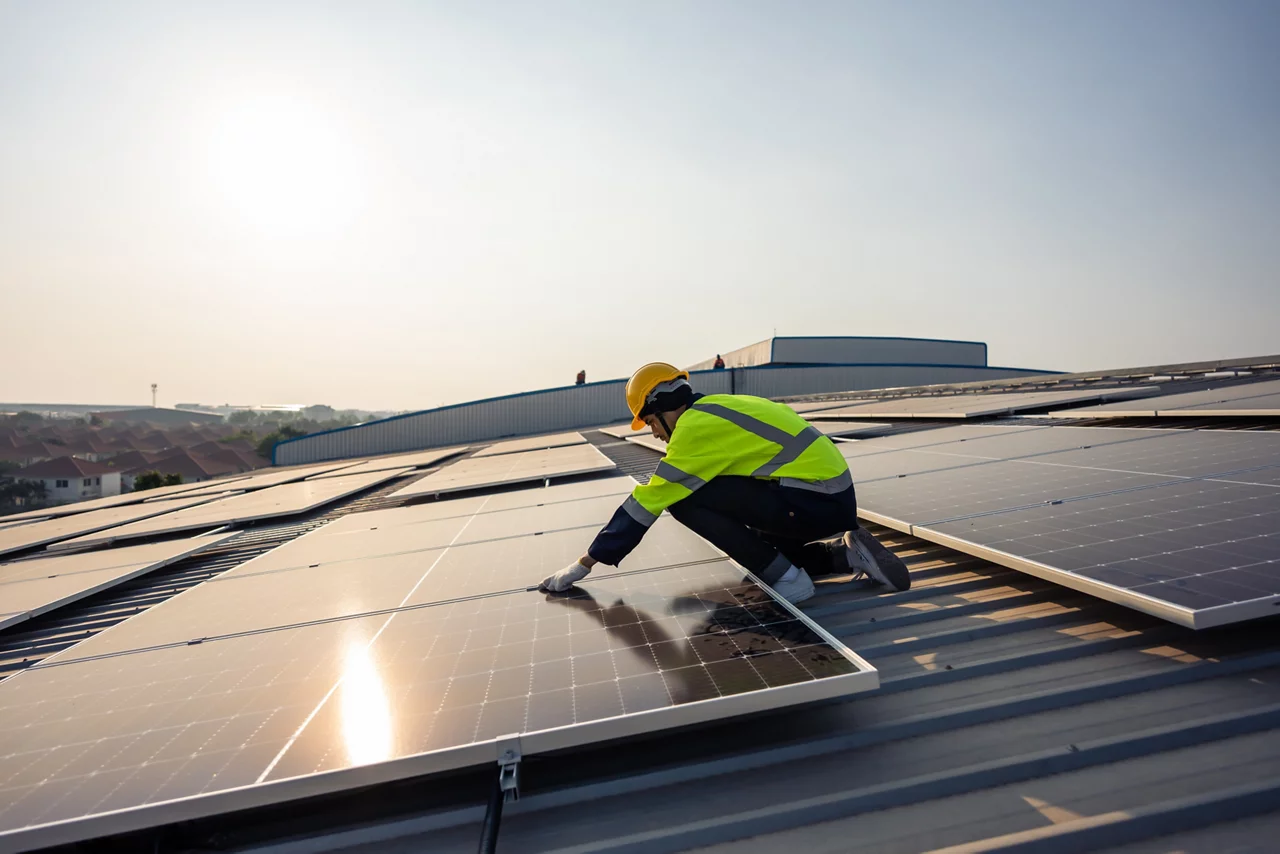
As commercial real estate owners face constant pressure to optimize asset performance and diversify operating income, the rooftop solar lease has emerged as an opportunity to monetize otherwise underutilized rooftop space through a long-term lease structure. In rooftop solar leasing, a property owner receives contractual revenue by leasing rooftop space to a solar developer who finances, installs and maintains the solar array and sells the electricity directly to the utility grid. Like other rooftop lease structures, the solar developer’s operations are independent of the building’s tenant. This structure is often referred to as front-of-the-meter (FTM) solar, distinguishing it from behind-the-meter (BTM) arrangements where solar-generated electricity is used onsite by the tenant.
The solar rooftop model value proposition
The low-energy intensity of I&L, specifically in warehouse and distribution buildings, is one of the defining reasons why FTM works particularly well in this asset class. Warehouses and distribution centers consume less energy per square foot than any other major property type.
The result is a mismatch between rooftop potential and onsite use: warehouses have some of the largest, flattest roofs in commercial real estate yet consume a fraction of what those rooftops could generate. BTM solar can serve the building's own load but typically only uses around 20% of the available rooftop area to do so, while FTM systems can cover nearly the full rooftop.
The FTM model captures this full rooftop potential as a discrete, contracted operating income stream, with limited ongoing owner involvement and no owner capital expenditure. Its long-term nature provides an income buffer independent of building occupancy, helping stabilize cash flow across market cycles, and because the income is separately contracted, it can be valued directly using established appraisal methods. BTM arrangements, by contrast, are often structured as a tenant perk, where value flows to the asset through rent. This can take the form of a contractually specified rent premium or, more informally, an amenity that strengthens market competitiveness – much like a gym in an office building. In either case, a buyer reviewing the rent roll sees a single lease rate with no visibility into how much, if any, reflects the solar installation, making it hard to treat as a discrete, reliable input to asset value.
Current state of FTM market readiness
FTM rooftop solar has gained significant traction in markets where state policy, regulatory frameworks and utility economics align to create favorable returns for both solar developers and property owners.
The viability of this model sits on a spectrum primarily shaped by state policy and local energy market economics. As of this publication, New Jersey, Maryland, Illinois, New York and Massachusetts represent the strongest current FTM markets.
The geographic concentration of FTM viability is currently narrow. Looking at total stock and development pipelines across U.S. industrial markets, 23% (3.6 billion square feet of 15.7 billion square feet) of total inventory sits in the most established FTM markets. The remaining 77% represents a meaningful pool of underutilized potential across states with significant I&L inventory and growing distributed generation demand, but where policy frameworks and energy market structures have yet to fully enable FTM deployment at scale.
Case studies: Valuing rooftop FTM solar in I&L today
Under a FTM structure, the power flows to the local utility grid rather than the building. The tenant's energy supply is unaffected, but the building gains a new revenue source. These case studies address two questions:
How is FTM solar lease income reflected in asset value?
How much value does such a lease add?
Approaching the valuation
To quantify the impact of a FTM rooftop solar lease on I&L asset value, we applied a methodology consistent with established U.S. appraisal and international valuation guidance and validated by JLL's Value & Risk Advisory team.
The rent paid by the solar developer is contracted, fixed-term income from a third party. It is not traditional real estate income as the lease has no exposure to the underlying tenant's covenant and no exposure to occupancy or rental growth. For these reasons, established appraisal practice treats solar lease income as a separate income stream, valued on its own terms and then added to the underlying real estate value to arrive at a combined asset value.
The closest analogue in the market today is the rooftop telecommunications lease, often comprising a tower or infrastructure situated on the roof of a building. This type of lease structure has been valued by appraisers for more than 40 years. Like a telecom lease, considered to be ‘short-term’ income, the solar lease delivers a fixed-term, contracted rent stream from a counterparty whose credit-risk profile, not the building's, determines the riskiness of the cash flow. Treating solar leases on the same footing connects the practice to a well-understood, market-accepted precedent rather than asking buyers and sellers to underwrite something unfamiliar.
The technique itself utilizes a discounted cash flow (DCF) of the contracted lease income over its term, which is 20 years in these case studies. The discount rate is calibrated to reflect the credit-risk profile of the lessee rather than the underlying real estate yield. While solar interconnection rights typically extend beyond the contractual term, and a landlord may well negotiate a new lease at year 20, the income is not capitalized in perpetuity. This is because renewal is not contractually guaranteed and would be priced under future market conditions that cannot reasonably be forecasted today. Valuing only what is contracted keeps the analysis grounded in what a buyer can underwrite today at the point of transaction.
To test the methodology, JLL experts modeled a 200,000 square feet Class C I&L asset in New Jersey with a 2,120 kW DC rooftop solar lease. The contracted lease adds $1.7 million of value to the asset at the base case, lifting total value from $39 million to $41 million. This represents a 4.4% uplift over the business-as-usual (BAU) building.
To assess an asset in a different market and product class, JLL experts also modeled a ~300,000 square feet Class A I&L asset in the Baltimore-D.C. market with a 2,570 kW DC rooftop solar lease. The contracted lease added $2.4 million of value to the asset at the base case, lifting total value from $65 million (BAU building only) to $67.5 million, representing a 3.7% uplift over the BAU building.
While the roof remains essential to building operations, it has not historically been treated as a revenue-generating surface. A rooftop solar lease changes that, turning a functional component of the asset into a contracted income stream. Taken together, the two case studies answer the questions posed at the outset:
How is FTM solar lease income reflected in asset value?
Through a discounted cash flow of contracted lease income over its term, valued separately from the underlying real estate and added to the building's asset value. This treats solar lease income on the same footing as other established contracted income streams such as rooftop telecommunications, anchoring the practice to a market-accepted precedent.
How much value does such a lease add?
Across two different markets, asset classes and vintages, a contracted FTM rooftop solar lease delivers a comparable uplift, ranging from 3.7% on a Class A asset in the Baltimore-D.C. area to 4.4% on a Class C asset in New Jersey. These are not benchmark figures. The uplift on any specific asset will vary with asset specifics, lease structures, the credit profile of the solar developer, broader market dynamics and the FTM policy environment. Still, in an asset class where valuation impacts at much smaller scale are actively pursued, the 3–4% value uplift demonstrated in this analysis is a material lever in the broader effort to optimize asset performance.
This is what the methodology supports today. As the market continues to price in the value of this additional income stream, valuation practice for FTM solar will evolve alongside it.
Market perspectives
Whether FTM rooftop solar is recognized as a contributor to I&L asset value depends on alignment across the parties involved in a transaction. Solar developers build the project economics; owners weigh the income stream against administrative effort and impact on asset value; brokers position the income at sale; and valuers calibrate it against established practices. Occupiers hold varying views on the model, which can shape how readily owners engage. Each sees a different piece of the picture, and each is working through what the FTM model means for how they engage with the asset. The perspectives that follow draw on interviews across these roles, surfacing where agreement has settled into market practice and where friction still remains.
FTM rooftop solar belongs in the I&L value conversation
I&L rooftops hold a meaningful, untapped source of value, and FTM rooftop solar offers an optimal approach to unlocking that value in I&L assets today. The analyzed case studies show that a contracted FTM lease delivers a value uplift of around 4%, fully attributable to contracted income from an otherwise underutilized rooftop space. The methodology to recognize that value, a discounted cash flow over the contracted term valued separately from the underlying real estate, is established appraisal practice and is being applied by institutional buyers in the most active FTM markets.
The model is also still maturing. As the body of transaction evidence for FTM-leased assets deepens and the grid context continues to intensify, the value contribution of rooftop solar is poised to be recognized more consistently across markets, asset classes and valuation approaches. For I&L owners, the case for engaging with FTM today rests on what the methodology already supports: a defensible income stream, a quantifiable value impact and a roof that is doing more than supporting the building below it.
1Source: JLL Research. Rooftop solar generation potential calculated using JLL's tracked I&L property database, filtered to buildings of 100,000+ square feet. Commercially suitable rooftop area estimated at 7.8 billion square feet after applying a 66% factor for obstructions, setbacks and structural constraints. Generation potential modeled using state-level solar irradiance (NREL data) and modern PV module efficiency. Household equivalents calibrated to state-level average annual residential electricity consumption (EIA).
Want to learn more?
Get in touch with our research team to find out how we can support your real estate strategy with market insights and strategic advice.