Public transit is a major focus in Asian cities and as countries urbanize, we expect more TODs.
02 December 2025
Insight
02 December 2025
TOD: a practical planning strategy for Asian cities
Categories:
Authors
Chua Yang Liang
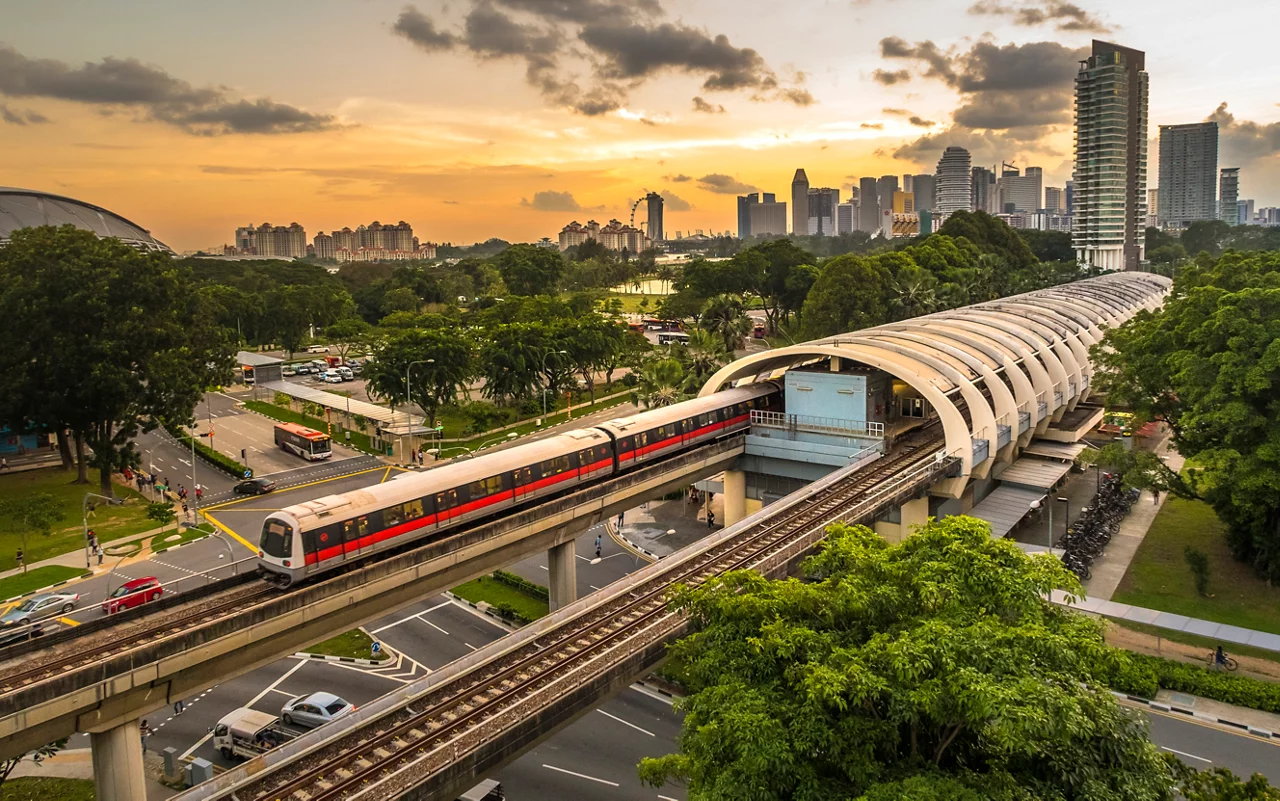
Anyone who grew up in Singapore’s public housing estates (HDB) in the 1970s and 80s will remember the familiar town centres. These were modern versions of the traditional town square, influenced by Ebenezer Howard’s Garden City ideas. Town centres brought together everyday needs: provision shops, clinics, wet markets, hawker food, libraries, and HDB branch offices. Sports facilities and the bus interchange were usually nearby, and residential blocks surrounded the core. Even if you didn’t live next to it, most residents were only a short bus ride away, with small retail clusters scattered throughout the neighbourhoods.
These centres were designed for towns of roughly half a million people, ensuring that daily life—shopping, services, work access—could be organised around efficient public transport rather than private cars.
By the 2000s, the function of town centres remained, but their form changed. Many are now anchored by multimodal transit interchanges where MRT lines meet buses, taxis, and cycling routes. Cities such as Copenhagen, Hong Kong, Osaka, and Singapore have long recognised the value of building homes, jobs, and amenities around strong public transit networks. The benefits are consistent: reduced car dependency, lower emissions, higher productivity, and better access to services.
On the other side of the world, city planning followed a different path. In 1935, Frank Lloyd Wright proposed Broadacre City, a car-centred, low-density ideal where each family lived on a one-acre plot. His vision reflected American values of autonomy and self-sufficiency and was shaped by the overcrowded industrial cities of the early 20th century.
But by the 1990s, rising environmentalism and growing sprawl led to a shift. Urban designer Peter Calthorpe popularised the term Transit-Oriented Development (TOD) as a structured response to car-dependent suburbia in his book “The Next American Metroopolis” in 1993. His idea was straightforward: put homes, retail, and community facilities within walking distance of a transit station, and design the neighbourhood for people —not cars.
TOD like the integrated development with multimodal transit interchanges in HDB town centers, is part of a simple philosophy: cluster jobs, housing, and amenities around reliable public transport. The World Bank has highlighted TOD as a proven strategy for improving productivity and environmental outcomes. But it also emphasizes that TOD principles should be adapted to local realities, assessed through three lenses:
1. Transit connectivity
2. Quality of the built environment
3. Market feasibility
No single TOD template works everywhere; context matters.
The Asian Model Will Keep Evolving
Singapore’s town centres will continue to serve as major gateway where multiple transport modes converge and connect residents quickly across the island. The town centre is both an infrastructure node and a “third place”—a shared social environment where people gather, interact, and weave community ties.
Across Asia, TOD is gaining momentum. Indonesia, Malaysia, and Vietnam are adopting their own versions as they urbanise and expand their transit networks. Each city will adapt the model to its own culture, demographics, and market conditions—just as Singapore and Hong Kong have done differently despite similar densities.
What remains constant is the underlying logic: transit-oriented planning creates more efficient, more sustainable, and more liveable cities. As urbanisation accelerates, TOD will continue to shape how Asian cities grow, offering a practical framework that balances mobility, community, and economic potential.