Through employee-focused design, technology companies can create engaging workplaces that spark innovation.
29 July 2025
Insight
29 July 2025
Designing magnetic workplaces
Categories:
Authors
Justin Kenyon
Introduction
In the high-stakes race for technology innovation, the workplace has become more than a backdrop—it’s now a strategic lever for growth, culture, and competitiveness. In the technology sector in particular, AI is reshaping everything from investment priorities to talent demands. Now, technology companies must rethink how their spaces support both people and progress. The emerging imperative: design flexible, cost-efficient environments that don’t just accommodate work—but inspire it.
If your company is concerned about how best to future-proof its spaces for evolving workplace expectations, you’re not alone. According to a JLL Research survey , only about half of all technology companies have optimized their corporate real estate (CRE) portfolios for new ways of working. Many tech companies are still seeking the right approach for modernizing their workplaces, to support potential future headcount needs while staying cost-conscious.
Evolving priorities and expectations
Today’s employees are looking for more than just a desk—they’re seeking spaces that reflect their values, support their well-being, and enable meaningful collaboration. Employees have come to expect flexible work options, and also want the office to provide a productive, enjoyable experience that justifies the commuting time. Furthermore, data finds that productivity tends to surge with in-person workplace experiences.
Big Tech companies are pouring investments into artificial intelligence innovation and want to reduce their footprints and real estate costs through higher-density office layouts and consolidations. For companies racing to invest in AI and innovation, there’s an urgent need to ensure that physical environments don’t fall behind. That means designing workplaces that can evolve in step with emerging workstyles, while supporting community, learning, and flexibility.
The landscape of workplace planning is becoming increasingly complex, driven by a confluence of factors. Organizations are balancing hybrid work models, evolving employee expectations, and a renewed focus on portfolio optimization. Many tech companies continue to maintain a hybrid program, however optimizing space utilization is the primary goal of these hybrid programs, cited by 100% of organizations. These shifts, coupled with the need to enhance collaboration and focus spaces, create a multifaceted challenge for corporate real estate leaders. As companies aim to increase seat-sharing ratios and improve density metrics, the need for sophisticated planning tools and strategies becomes paramount.
Three keys to creating the right workplace modernization strategy
A “one size fits all” workplace strategy does not exist. In general, however, most technology company offices are transitioning from assigned desks and enclosed meeting spaces to more collaboration space, shared seating and more flexible floor plans. Optimizing the workplace for multiple ways of working means balancing the areas of flexible versus fixed environments, workspaces for collaboration versus individual work, and efficiency versus comfort.
“Every technology company must navigate its own journey toward a holistic approach that balances cost efficiency, employee experience, and corporate flexibility goals,” says Justin Kenyon, Managing Director, Technology Division, JLL.
The following three principles will help you begin the journey to future-proofing your technology company workplace.
1) Build in flexibility
The continued advances of AI and other innovations could mean future changes in headcounts, space needs and workplace requirements, so it’s no surprise that agility has become a workplace and portfolio imperative across many industries. Flexible work environments allow you to quickly reconfigure spaces to meet changing needs and priorities.
To optimize space, more technology organizations are adopting data-driven hybrid work strategies, emphasizing structured in-office schedules that not only create for predictable attendance patterns, but also encourage in-person collaboration beneficial to innovation. Organizations are evolving their space designs to support diverse work activities. These designs enable employees to seamlessly transition between interacting with others—whether in-person or virtually—and concentrating on heads-down work without interruption.
To mitigate costs, one strategy is to develop modular, reconfigurable spaces that can quickly transform between different work modes, rather than making permanent, inflexible changes. Examples include moveable walls and easy-to-reconfigure modular furniture, along with ample power outlets and robust Wi-Fi to enable mobile working around the office. This way, a large space could be used for a training program one week and divided into multiple spaces for various project teams the next.
Adaptability should extend to furniture systems, technology infrastructure, and space allocation processes.
2) Design for employee needs, not for square footage
In the past, common workplace practice was to design corporate offices around dedicated workspaces, conference rooms and ancillary spaces in a fixed layout. Today, leading practice is to instead create a human-centered, dynamic ecosystem of workspaces that empower employees and create an enjoyable, productive experience. According to HP’s 2024 Work Relationship Index report , 87% of employees would trade a portion of their salary for a more tailored, engaging workplace experience. Furthermore, over 69% say a personalized approach to work would actively incentivize them to stay with their companies longer.
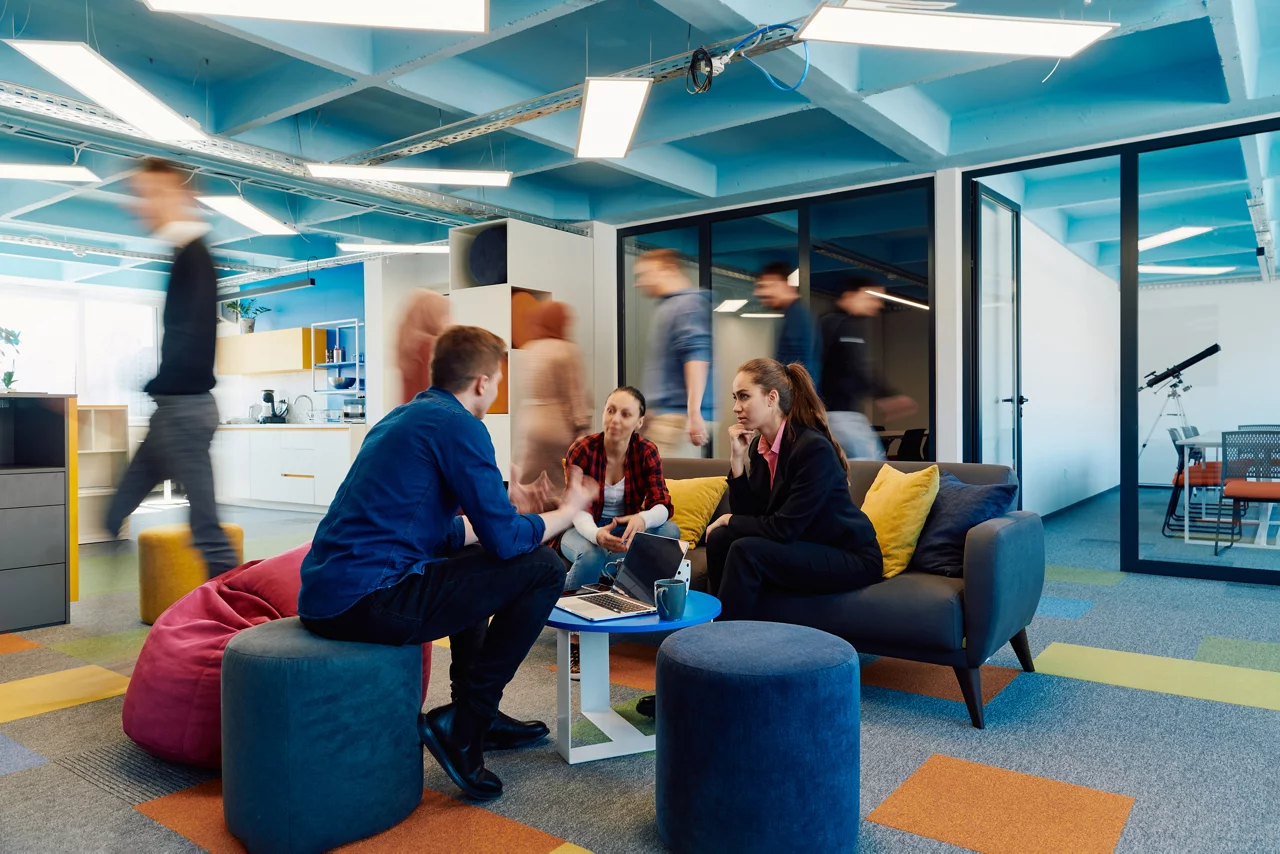
Among technology companies, the most effective workplaces are those that provide different kinds of spaces for different kinds of experiences. While employees today are most likely to choose the office for collaboration, learning, mentoring and socializing with colleagues, many also need the office to provide a productive environment for focused work.
It’s important to recognize employee needs for quiet and privacy versus socializing and collaboration, whether face-to-face or with remote colleagues. Options typically mean private booths for video meetings and phone calls; quiet-zone rooms and individual workspaces for focused work; a café or cafeteria for socializing; collaboration areas for group work and incidental booths or seating for informal conversations.
Since workplace design has a significant impact on employee performance and wellbeing, it’s important to pay attention to the issues that generate the most common complaints: noise, temperature and workspaces for individual work. Also important are design elements that foster wellbeing and creativity. Natural light, outdoor views and spaces, open sightlines, plants and sustainable materials bring a connection to relaxation and nature that can relieve stress and encourage creative thinking essential to innovation.
3) Leverage data
Workplace strategy decisions are most successful when informed by data and information about the employee experience in your space. Quality data is paramount in making impactful decisions rather than simply collecting large amounts of information. In fact, according to the 2025 Technology Spaces Report, only 20% of technology companies have excellent capabilities to track hybrid programs (compared to just 7% across all industries).
For an accurate picture of how and when space is being used, turn to data and analytics tools that reveal real-time trends and generate predictive insights. In fact, organizations with advanced data capabilities gain significant advantages. Among technology companies, 76% of occupancy planners use utilization data to aid in design, helping create spaces that truly meet employee needs.
Potential data sources include Wi-Fi network metadata, wireless workplace sensors, or room reservation software that indicate which spaces are most or least utilized. With data and analytics tools, you may learn, for example, that small meeting rooms are constantly full while larger rooms are consistently under-utilized. Based on that insight, you could reconfigure the office with fewer large conference rooms and more small meeting spaces.
Taking a strategic approach to data collection is essential. This means aligning your objectives with an overall business strategy, determining KPIs, and identifying specific metrics that will support decision-making. Consider linking disparate data from cost, space, and human-centric metrics to create a comprehensive "Workplace Vibrancy Index" that provides a holistic view of your workplace's effectiveness.
In addition to shaping data-driven workplace and portfolio strategies, you can also leverage technology to create a more productive and enjoyable employee experience. Mobile apps, room reservation systems and collaboration technologies can improve the employee experience by streamlining routine tasks and making it easier to focus on the work at hand. With smart building technologies, you also may be able to give employees more control over the temperature and lighting of their workspaces—addressing top office complaints.
Finding the right approach for your organization
For every technology company, the journey to an efficient and effective workplace is complex. Leading technology companies are successfully balancing competing business priorities by assembling an experienced team to help modernize their offices for the future of work. By keeping your organizational culture and employee needs front and center, you can arrive at a flexible, cost-efficient workplace that helps attract and train the talent that drives innovation.
"To thrive in today's tech landscape, companies must recognize that the workplace is no longer a static entity but a dynamic tool. By building in flexibility, designing for employee needs, and leveraging data, we can create magnetic environments that attract, engage, and inspire top talent," says Kenyon.
The tech industry, driven by innovation and talent competition, is at the forefront of evolving workplace expectations. CRE leaders must recognize the shift from traditional office spaces to dynamic ecosystems that prioritize employee experience and adapt to changing work styles.
To learn more about how JLL can help you optimize your real estate strategy in this demanding ecosystem, visit https://www.jll.com/en-us/industries/technology.