This article marks the start of a series that provides a comprehensive guide to end-to-end circular fit-outs.
29 July 2025
Guide
29 July 2025
Why circular fit-outs make environmental and commercial sense
Categories:
Authors
Hendrik Wetzke
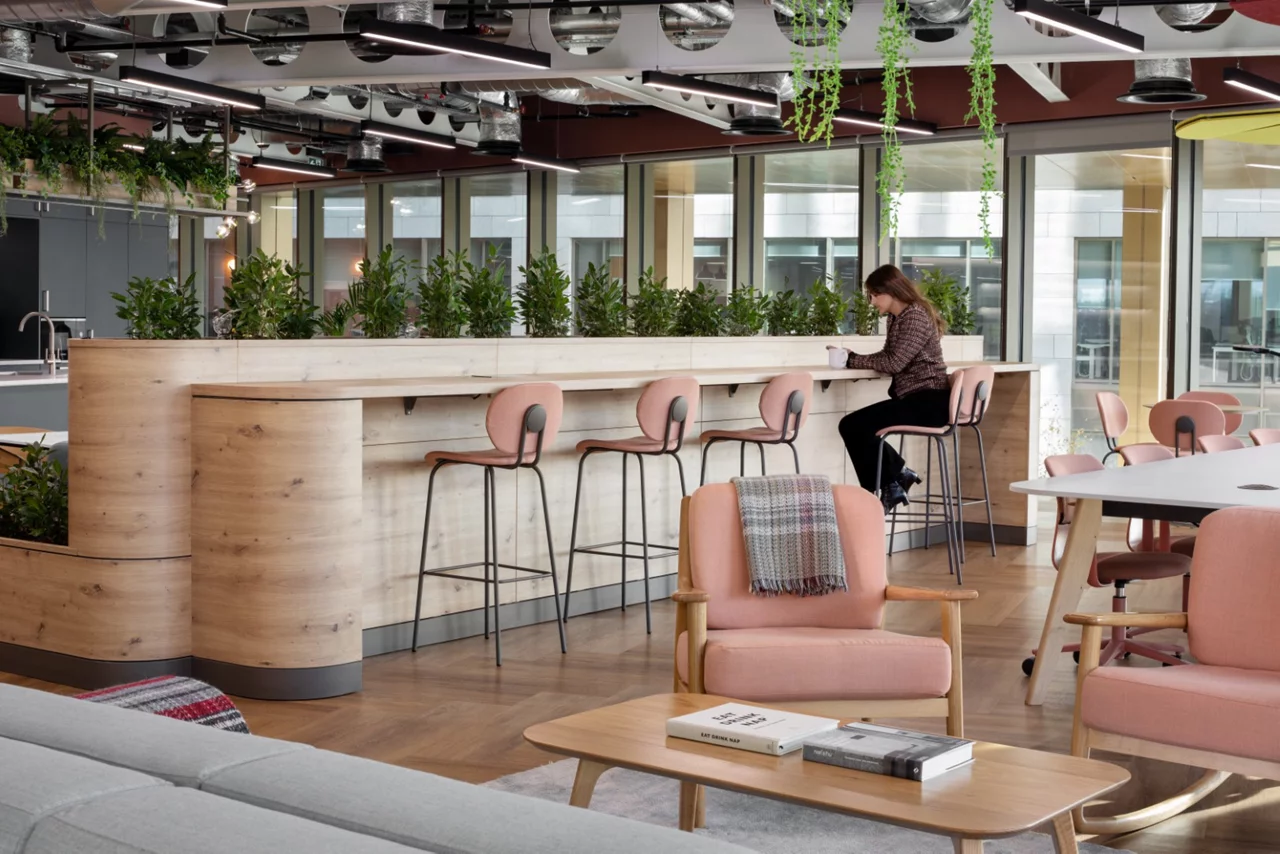
As firms look to reduce both carbon emissions and costs, circular principles are starting to reshape office fit-outs. It’s simple in theory: reduce waste, reuse what’s already in place and design for future adaptability. But, in practice, this challenges deeply embedded processes across commercial real estate leasing, design, procurement and project delivery.
"It’s early days but there is a growing interest from occupier clients to understand how they can embed circularity in practice and what the benefits are,” says Areti Makantasi, Director of Sustainable Asset Services, JLL.
Reducing carbon and cost
As costs rise and companies continue to seek more adaptable workspace, circularity can deliver multiple benefits, including a clear sustainability imperative. While most occupiers are committed to cutting their operational carbon output, the carbon impacts of fit-outs can be significant, especially with relatively short lease periods. This results in more frequent fit-outs in the lifespan of a building.
But the circular approach also makes commercial sense — keeping materials in use for longer, whether it’s kitchen joinery, glazed partitions or furniture, can deliver measurable cost savings. In one case, JLL negotiated to retain an outgoing tenant’s fit-out, which saved the new tenant 75% compared to the expected costs for an all-new CAT B fit-out.
Re-using furniture, fixtures and fittings has saved other clients as much as 42%*.
Despite the evidence in favour of circularity, several barriers hinder its adoption as a mainstream principle in office refurbishments. One of the biggest obstacles is psychological, but other significant challenges exist. The marketplace for reused materials is not yet mature enough, and there is often a lack of data on available reused materials and products to enable informed decision-making. These factors combined make it difficult for stakeholders to fully embrace circular practices in office renovations, despite their potential benefits.
As working styles and technology have fundamentally altered how and where people work, workplaces have evolved, too. Yet the fit-out process remains largely the same – to dispose of the old and start fresh.
"We’ve been doing things the same way for the last 20 years and we're now talking about doing it differently," says Kirsty Draper, Head of Sustainability, Leasing, JLL. "There is a mindset and behaviour shift that needs to happen."
There has been a perception that second-hand means second-best but the reality, as JLL’s own workplace projects show, is different.
"We're advising our clients to look at their existing fit-out as an asset and a material bank for moving to the next office," says Laura Wardrope, Associate Project Manager - Occupier Fit-Out, JLL. “All materials should be viewed as assets rather than something to be disposed of.”
Why mindset matters
This view also connects circular thinking to dilapidations. Traditionally, tenants are expected to remove their fit-out at lease end, regardless of quality. A circular approach considers future use at design stage, avoiding waste and creating value for the next occupier.
Jon Rowling, Director of dilapidations (reinstatement) and dispute resolution, JLL UK, describes the end of a lease as like a "messy divorce": "No one wants to give more than they have to and so landlords may want to demonstrate how much the dilapidations works cost," he says. "That often means ripping out perfectly good interiors just to reinstate Cat A, often at great cost and waste."
Shifting the mindset from stripping out and starting over to adapting and improving is beginning to take hold, but it’s not yet a common feature when occupiers are deciding whether to stay or go. Circular procurement takes time, sometimes six to eight weeks more than standard routes, and requires coordination between disciplines.
"That early engagement is key," Wardrope adds. "It’s where we’ve seen the most success, not just saving money, but avoiding waste altogether."
In many cases, the planning needs to begin even before a lease is signed.
"We’re asking clients to think differently, to plan earlier, to allow more time," says Johana Rodriguez, Sustainability Manager, JLL Design Lab.
This approach means that circularity can be embedded end-to-end. Another challenge is the lack of formal infrastructure around materials reuse and storage.
"We don’t have a marketplace that fully supports the storage of those materials, like a material bank for both Cat A and Cat B fit-outs, and that’s a real barrier to secondary procurement,” says Draper.
Until then, success hinges on early alignment and appropriate project management.

Not just good practice, best practice
Crucially, circularity doesn’t demand perfection. "You don’t have to do everything all at once," Draper adds. "Even incremental change matters; sometimes it’s just keeping one element, or sourcing one thing differently, that still makes a difference."
Encouraging clients to procure reused items from other projects or from second-hand retailers is increasingly part of the fit-out conversation.
"We’re seeing a really good response," says Rodriguez.
"Donation is always an option, remanufacturing furniture is getting more common. It’s about taking the fear out of reuse for the client. We’re supporting this shift with practical tools and platforms that make circular decisions easier to adopt across projects."
The most successful circular fit-outs are those that see the process not as linear, but as a loop, where today’s office becomes tomorrow’s material bank. That relies on joined-up working across leasing, design, sustainability and project management. It may not yet be the default, but it’s fast becoming the benchmark.
*A leading sportswear brand saved 42% through reuse of existing furniture, showroom fixtures and fittings, and joinery items such as the kitchen.