Designing workplaces that serve today's needs while adapting to tomorrow
15 April 2026
Insight
15 April 2026
Why human connection matters more than ever in the age of AI
Categories:
Authors
Farah Addada
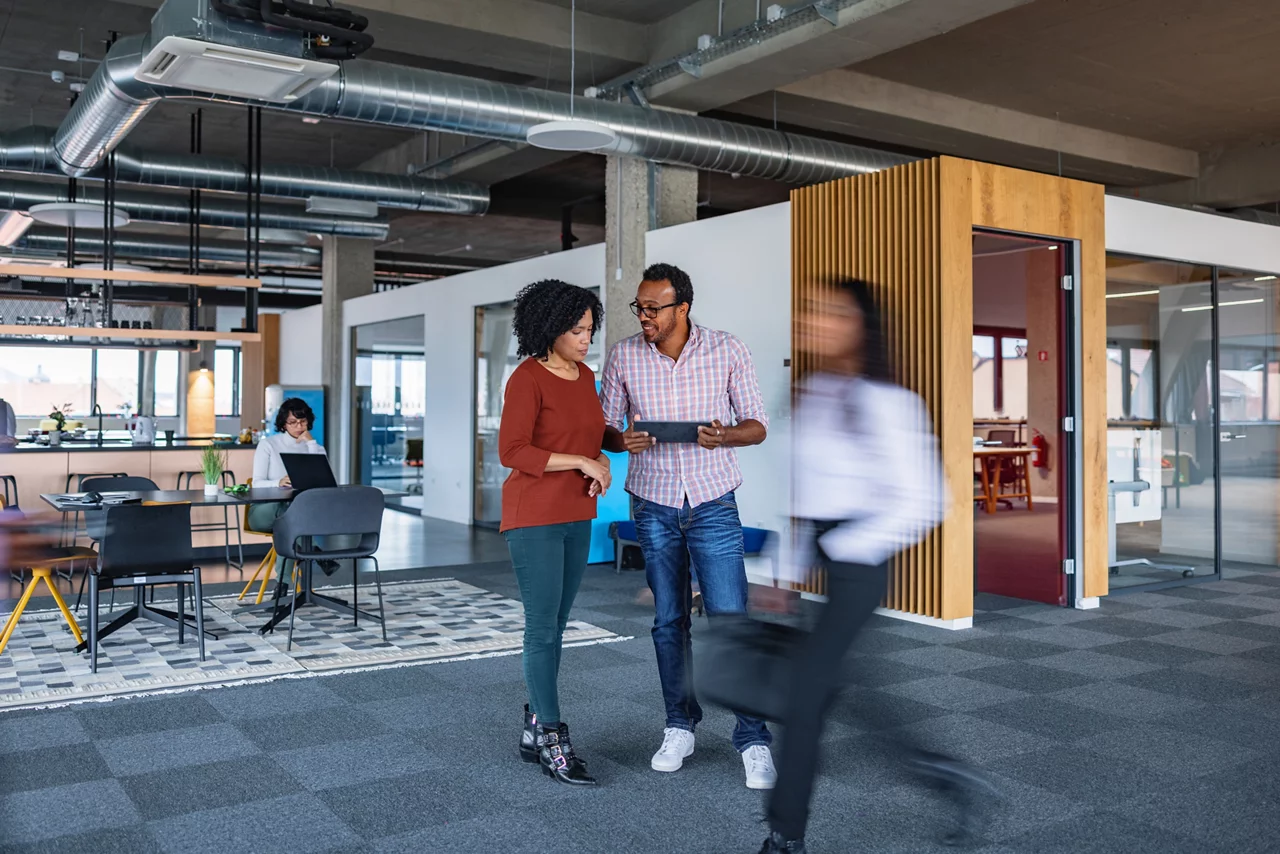
For UAE business leaders today, the question isn't whether workplace design matters—it's how to create spaces that meet today's needs while staying flexible enough for tomorrow's unknowns.
JLL's Global Design Perspectives 2026 research reveals four interconnected trends reshaping workplace strategy across the UAE and EMEA region. What's interesting is that these aren't isolated trends requiring separate solutions. Instead, they're converging forces that, when understood together, offer a practical framework for creating workplaces that deliver lasting competitive advantage.
1. Hardwired for flexibility as strategic infrastructure
Leading organizations are rethinking flexibility. Rather than viewing it as just a design feature, they now recognize it as a core infrastructure strategy.
Business planning agility, operational efficiency, and evolving technology needs have become the top three priorities for C-suite leaders over the next three years. This shift reflects an important realization - in an era marked by uncertainty and rapid technological change, a company's ability to adapt often determines whether it thrives or struggles to keep pace.
Within UAE, many organizations are embracing this reality by prioritizing technology-enabled spaces in their capital investments. But there's a deeper strategic insight here that goes beyond simply upgrading conferencing systems. The real question leaders should be asking isn't "What technology do we need today?" but rather "What infrastructure will let us adopt technologies we haven't even imagined yet?"
Think about what this means in practice. When your power systems can scale, when connectivity can evolve without major infrastructure overhauls, and when spaces can be reconfigured without demolition, real estate shifts from being a fixed cost to becoming a dynamic strategic asset. The pandemic taught us this lesson clearly—organizations with flexible spaces adapted quickly, while those with rigid, purpose-built environments faced significant challenges.
This shift calls for a fresh approach to capital allocation. Traditional CapEX and ROI models focus on known requirements over set timeframes. But future-ready models recognize something different—that the greatest value often comes from optionality, or the ability to pivot when things change without facing prohibitive transition costs.
So the key question becomes: what investment today creates the most strategic flexibility for tomorrow? Organizations that thoughtfully address this question will find their real estate enables business agility rather than limiting it.
2. AI advances the value of human connection
Something counterintuitive is happening. As AI capabilities expand, physical workplace environments designed for human connection are becoming more valuable, not less.
The data tells a clear story. 64% of the people interviewed want places that offer unique and distinct experiences, while 63% seek connection to their local area or culture. These aren't just passing preferences—they reflect fundamental human needs that become even more important as our digital interactions increase.
AI is exceptional at optimization, pattern recognition, and processing enormous amounts of data. But there are things it simply can't replicate. It can't recreate the creative friction that happens when diverse perspectives meet in person. It can't build the trust that comes from shared experiences. And it can't orchestrate those unplanned moments such as the hallway conversation that sparks innovation, or the casual interaction that solves a problem no one could tackle alone.
This insight is reshaping how we think about workplace design. The question isn't whether people need to be physically present. It's about understanding what unique value in-person interaction creates that virtual meetings simply can't match.
The answer increasingly points to designing spaces for human connection using principles rooted in neuroscience. Research shows that tactility, texture, and materials significantly enhance both experiences and cognitive performance. This isn't about aesthetics; it's about recognizing that certain environments genuinely help people think and interact more effectively.
A great example of this thinking in action is the office project for an investment leader in Dubai. The workspace was redesigned as neighborhoods, with wide passages and designated areas for conversation and collaboration that encourage spontaneous connections across departments.
As AI takes on more tasks, the real value of physical workplaces increasingly lies in supporting uniquely human capabilities such as creativity, relationship-building, and complex collaboration that technology still can't easily replicate.
3. Evolving personalization balances individual needs and organizational efficiency
Consumer technology has fundamentally changed what people expect from personalized experiences. These expectations are now flowing directly into workplace design, creating both exciting opportunities and real challenges for UAE organizations.
The numbers are striking: 72% of people expect brands to recognize them individually and offer customized experiences, while 65% look for engaging events and experiences. Workplaces can't ignore these expectations without risking their ability to attract and retain talent.
What makes this particularly interesting is how different generations view personalization. Among 18-34 year olds, 65-71% believe AI integration will meaningfully enhance their experience through personalization. That drops to 48% for those aged 45-54, and falls to just 26% among professionals aged 55-64.
This creates a real challenge for UAE workplaces serving multiple generations. Success means finding the right balance between AI-driven personalization and creating environments that work well across diverse preferences and comfort levels.
The solution isn't endless customization as that wouldn't be practical or cost-effective. Instead, it's about offering meaningful choice and variety that respects different work styles, preferences, and needs. Some people do their best work in energetic, bustling spaces, while others need quiet for deep concentration. Some teams collaborate best in formal settings, while others thrive in casual configurations.
Forward-thinking organizations are creating systems where employees can choose workspace types based on what they're doing that day - quiet zones for focused work, collaborative areas for team sessions, comfortable settings for virtual meetings. Others are using occupancy data and space analytics to understand how people actually use spaces and optimize accordingly. The most advanced are introducing environmental controls that let individuals adjust lighting, temperature, and acoustics in their immediate area.
But there's a deeper insight here that goes beyond individual customization. It's about creating environments where everyone genuinely feels they belong. Research shows strong interest in welcoming and inclusive spaces across all generations, suggesting that effective personalization isn't just about individual preferences, it's about building genuine inclusivity.
4. From activities to outcomes through connected workplace design
Perhaps the most significant shift happening in workplace thinking is the move from designing for specific activities to designing for holistic business outcomes.
Research reveals an important gap. Employees rate things like recharging and wellbeing, working in inspiring environments, and experiencing company culture as highly important. Yet satisfaction with how current workplaces actually deliver on these needs is considerably lower.
This gap matters because organizational complexity and agile business needs are driving a shift toward high-performance environments as connected systems rather than just collections of separate spaces. Traditional approaches focused on functional areas for specific activities such as desks for individual work, rooms for meetings, areas for breaks. While these elements are still necessary, they're no longer sufficient for what organizations really need to accomplish.
Think about what workplace success actually looks like for a modern UAE organization. It's not about desk occupancy rates or meeting room bookings. It's about teams collaborating effectively across departments. It's innovation emerging from unexpected connections. It's employees learning and growing from their colleagues. It's people feeling energized by their environment. It is culture being lived through daily experiences, not just stated in mission statements.
Importantly, this need for holistic workspace experiences applies to both office and non-office workers. This challenges traditional distinctions between worker categories and suggests workplace strategy should consider the broader ecosystem of work, not just those who come to headquarters every day.
This perspective calls for different ways of measuring success. Traditional metrics like desk occupancy and meeting room bookings tell incomplete stories. They track activity but not outcomes. Research advocates for developing metrics that capture team performance, social capital, and experience quality, ensuring that investments in space align with what organizations actually need to achieve.
A path forward
These four perspectives - flexibility for the unknown, human connection in the AI era, evolving personalization, and designing for outcomes rather than activities - aren't separate trends to tackle one by one. They're interconnected dimensions that work best when integrated together.
The UAE is particularly well positioned to lead in this integration. The region's blend of ambitious vision and pragmatic execution, its role as a global crossroads where diverse perspectives meet, and its track record of embracing innovation while respecting human values create ideal conditions for workplace transformation.
Organizations succeeding in this space share some common traits. They're not chasing trends or copying fashionable workplace concepts. They're thinking carefully about what their people genuinely need to perform at their best, then creating environments that make those outcomes easier and more natural to achieve. They're balancing investments in cutting-edge technology with equal attention to human experience. And they're building spaces that are both visually appealing and genuinely functional for daily work.
This approach takes patience, thoughtfulness, and a willingness to invest in understanding what truly works rather than simply replicating what others have done. But the payoff is meaningful workplaces that actively contribute to organizational success, employee satisfaction, and long-term competitive advantage, rather than just housing operations.
Moving forward means integrating flexibility, human connection, personalization, and outcomes-focused design into cohesive workplace strategies. For UAE organizations ready to embrace this challenge thoughtfully and strategically, there's a real opportunity to create exceptional workplaces that serve as genuine competitive advantages.
Talk to us about how we can help you achieve your workplace design ambition.