Risk, Resilience and Adaptation
Insight
27 June 2024
The climate inflection point
Categories:
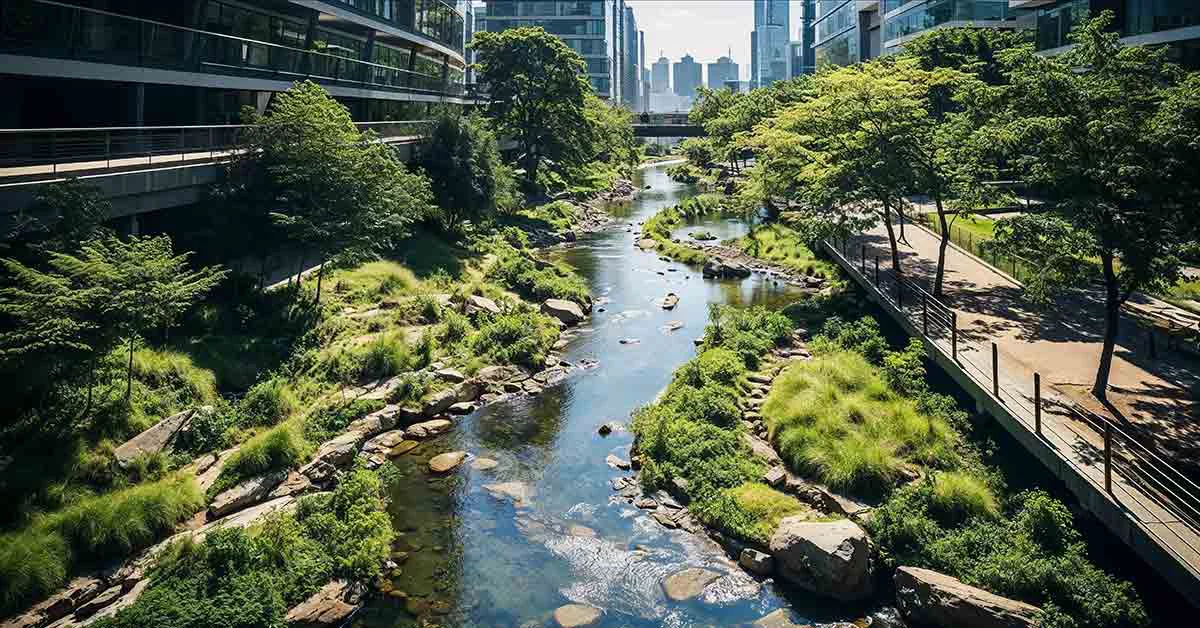
Image by Infini Craft- stock.adobe.com. This work product was created with assistance from generative AI.
Key Highlights
Act now. Climate change is already happening. We must act now to avoid its most detrimental effects and mitigate costly damages. All buildings will be affected, even in temperate climates.
Intensify collaboration. The climate resilience of assets and urban infrastructure is inextricably linked; resilient buildings require resilient cities. Collaboration between governments, owners, developers, occupiers, architects, and insurers is essential.
Be radical. Developing climate resilience will require radical hard engineering, nature-based and AI-powered solutions.
Climate change is here and there’s more to come
Climate change is a reality. Extreme climate events – heatwaves, flooding, storms and droughts – are increasing in both severity and occurrence.
No longer confined to the realm of academic discussions or distant headlines, the impacts of climate change are seeping into the very fabric of real estate, demanding attention, adaptation, and action.
Targets to keep global temperatures within the critical 1.5°C threshold in line with the Paris Agreement are almost certain to be missed, and temperature rises are already baked in. Mean global temperatures have risen by 1°C in the past two decades, while 2023 turned into the hottest year on record and 2024 is likely to be even warmer.
Considering these trends, a recent survey of climate scientists by the Intergovernmental Panel on Climate Change (IPCC) found 77% foresee at least 2.5°C of global heating above pre-industrial levels this century if radical action is not taken.
Governments, owners and occupiers must make the built environment resilient to climate change, in tandem with decarbonization efforts.
Imagine a world where all buildings have to comply with strict ESG standards and climate adaptation becomes a necessity.
How could an existing building be retrofitted to be more sustainable and resilient? Our creative team has helped us visualize the opportunities.
In addition to the roof-top garden, electric car charging stations and cycle lanes, behind it are less-obvious changes, such as smart glass; passive design solutions for improved light and ventilation; key infrastructure moved to higher floors; heat pumps; and integrated building technology.
The business case for resilience and the cost of inaction
As weather patterns become more unpredictable and extreme weather events become more frequent, the risks to asset values will mount. One estimate has put US$1 trillion of real estate at risk of coastal flooding in the U.S. alone.
Organizations which don’t implement climate mitigation and adaptation strategies face disruption, damages, higher maintenance and insurance costs, coupled with lower revenues:
- More frequent and severe climate events will increase maintenance costs and insurance premiums. Less resilient buildings will become harder to insure, see lower tenant demand and thus fall in value.
- Disruption to operations and property downtime will lead to reduced revenues and increased costs.
- Resources such as energy and water will become more expensive for companies which haven’t adopted measures to reduce consumption.
- Increased regulations around climate risk reporting, such as the SEC legislation in the U.S. and CSRD in Europe will impose compliance mandates for large businesses.
Investors without climate mitigation or adaptation strategies are experiencing reduced liquidity and pricing impacts on asset sales. While this is not a new trend, it is becoming more prevalent as the understanding of the impacts and implications of climate risk increases. For example, in the UK, a prime retail park situated within a flood zone was recently brought to market without a full flood risk assessment (FRA), leading to a reduction in interested parties and likely material impact on pricing.
‘With the current short-term political uncertainty, economic growth opportunities in some markets may now lie in the scientific certainty of climate change adaptation together with emissions reduction.’
- Sonny Masero, Managing Director, Global ESG | Hines
How are cities affected?
Public investment in resilient infrastructure can mitigate physical climate risk. Some city administrations – such as Amsterdam and Paris – have been pioneers in developing resilience. Other cities, like New York were shocked into action through events like Hurricane Sandy. Likewise, in response to recent wildfires and associated smoke haze, Australia’s state and local governments are leading the charge to protect their urban areas from climate change through a series of planning and associated legislation relating to the built form and vegetation management.
What does a resilient city look like?
Around the world, cities will have to prepare and adapt to climate change in different ways.
Permeable pavements to reduce the risk of flooding, misting stations to help residents cope with more frequent and intense heat waves, buried power lines and reinforced foundations to mitigate storm damage are just some of the solutions that can make cities more resilient.
Although some cities are feeling the effects more acutely than others, all will face long-term challenges to existing buildings, infrastructure, and supply chains. For example, while European cities rank among the world’s lowest climate hazard scores, temperatures across the continent are increasing at a rate that is about twice as fast as the global average.
No asset is an island: resilient buildings require resilient cities
Climate resilience of a specific asset is determined as much by the resilience of its supporting infrastructure – transport, power, water and sanitation – as by the resilience of the asset itself. For this reason, investors will place a higher risk premium on properties in a city affected by climate events, regardless of whether individual properties are vulnerable.
Global studies find the benefits of investing in climate-resilient infrastructure outweigh the costs. Resilient infrastructure includes hard defenses, such as sea walls and flood barriers, as well as natural infrastructure, such as wetlands. Nature-based approaches are often cheaper.
What are companies doing today?
Extreme climate events are already affecting asset pricing and liquidity. Prices typically decline after climate events, particularly in locations not used to extreme weather. Overtime, repeated events can lead to significant price discounts and a drop in demand. In Hong Kong, for example, following a typhoon in October 2018, a multifamily residential building saw unit prices fall by 14% and not recover to pre-typhoon levels still four years later.
Even today’s prime buildings will need to adapt to a rapidly changing climate to maintain their appeal. More than 90% of the world’s largest companies will have at least one real estate asset financially exposed to climate risks by the 2050s, according to S&P Global.
However, climate risk remains a blind spot for many companies:
- Only one in five companies has a plan in place to adapt to the physical risks of climate change, according to the latest data from S&P Global. Real estate performs slightly better, with 26.5% adapting for physical risk.
- According to the World Economic Forum’s Global Risks Report 2023 ‘the failure of climate change adaptation ranks as the second-greatest risk for companies over the next decade’.
- While JLL's Decarbonizing the Built Environment report found 78% of investors and 83% of occupiers identify climate risk as a financial risk, a 2023 study from PwC found only 23% of executives are planning for disruptions in the next 12 to 18 months.
Companies often cite cost and lack of data as barriers to climate risk strategies. Additionally, absence of adequate policies, lack of standardization and limited education are barriers to the creation and implementation of climate risk mitigation and adaptation strategies. Collaboration involving government at all levels, asset owners, lenders, insurers and credit rating agencies is vital in driving investment into resilience.
An action plan for real estate – evaluate, adapt and act
Owners:
- Demand will shift in response to climate risk, so incorporate climate risk modelling into investment strategies. Avoid assets in places most exposed to climate hazards.
- Crucially, factor in city resilience strategies and the potential vulnerability of local transport infrastructure, power and water supplies to climate events.
- Adopt a holistic approach: evaluate physical climate risk and resiliency planning alongside decarbonization and asset repositioning.
- Identify the most vulnerable assets and work on resilience measures. Keep abreast of change and review climate risks annually.
- Engage and collaborate with other stakeholders to create and implement integrated resilience strategies.
Occupiers:
- Identify those sites most vulnerable to climate hazards and infrastructure failure, then strategize.
- Engage with landlords to establish contingency plans for extreme weather events and identify areas for longer-term collaboration. Ensure these are clearly outlined through green lease clauses.
- Develop and integrate resilience strategies to add long-term value with employee health and wellbeing needs, social impact and creating inclusive spaces.
- Communication and alignment between stakeholders at all levels, from suppliers to C-Suite, is imperative to climate mitigation and adaptation policies.
As the world grapples with the escalating consequences of climate change, the real estate industry finds itself standing at a precipice. In the coming years, the effects of climate change are set to deepen, presenting the industry with tangible and increasingly urgent material threats.
Explore more of JLL's latest insights on World Economic Forum themes at our dedicated Davos page.
Want to learn more?
To learn more about our Future Vision research program or to find out how we can support your real estate strategy with market insights and strategic advice, get in touch with our team.

Paulina Torres
Global Research Director, Sustainability

Kamya Miglani
Head of ESG Research, APAC

Jeremy Kelly
Director - Global Research

Dr Georgia Warren-Myers
Head of Sustainability Value and Risk, Asia Pacific
More from JLL’s Future Vision program