Firms are connecting ‘street to seat’ touchpoints for better employee experiences
02 May 2025
Insight
02 May 2025
3 ways retail is influencing workplace design
Categories:
Authors
Amanda Boulton
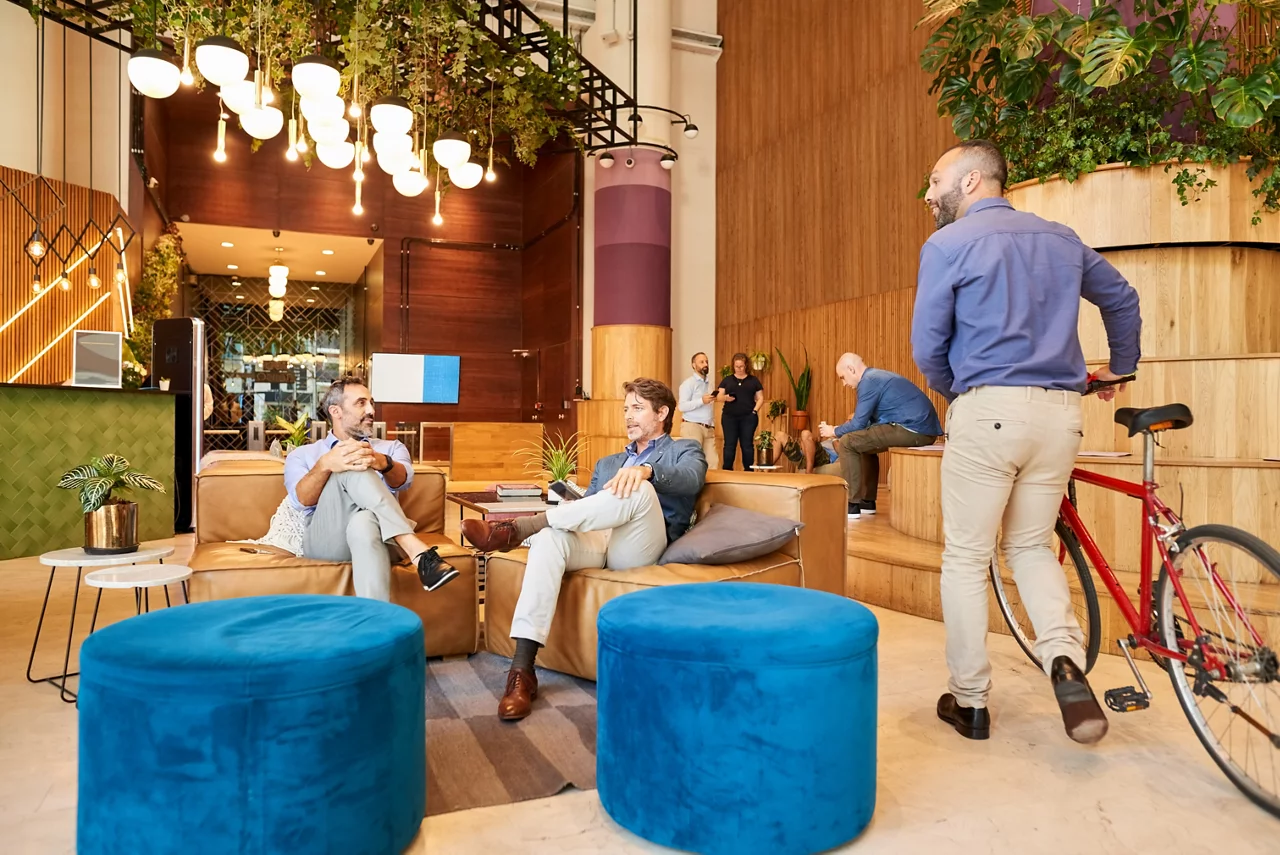
The retail industry has long understood that storytelling and design create memorable experiences.
Companies with office spaces are now analyzing those lessons as they increasingly seek to drive value through positive experiences.
“Retail is ultimately theatre and workplace design is no different,” says Stephen Jay, JLL Global Design Advisory Retail and Branding lead. “There are so many lessons from retail that can be applied to just about any space, including the office.”
JLL’s Design Trends survey identified that demand for increased in-office attendance means firms are focused on improving employee experience from ‘street to seat’, putting human-centric design in the spotlight. In fact 60% of organizations expect to spend more on design, fit-out and refurbishment by 2030, according to JLL research.
As organizations aim to create spaces that employees want to spend time in, we explore three ways that workplace designers are taking a leaf from the retail playbook.
1. Approach and arrival strategies
Retail customers often begin their journey by engaging with brands via websites, social media or campaigns promoting special offers or instore events.
Similarly, corporate organizations are now finding ways to excite employees before they even step inside the building.
Using a combination of apps such as HqO, internal communications and programmed workplace experiences, firms can give employees more reasons to make the commute with custom activities such as health and wellness weeks, guest speakers, lunchtime fitness classes or themed cafeteria dining options.
And when they get there, they’re greeted with acoustics that create the right mood, softer lighting and a quick blast of a soothing signature scent.
“Historically, office lobbies have been austere and cold, but in retail and hospitality, those first impressions are about creating warm gathering zones that welcome you the moment you come through the door,” says Diane Rambo, Senior Vice President Creative for JLL Design.
Take TravelPerk, which redesigned their headquarters so the building is accessed via a coffee bar called "The Platform," allowing people to immediately engage with friends and coworkers, while “The Arrivals Lounge” encourages informal and collaborative working.
2. Visual storytelling
People are increasingly seeking to engage with places or brands that reflect their values, according to JLL’s Global Consumer Experience survey.
“Too often corporations have to tell you their values or literally write them on the wall,” says Rambo. “What retailers do so well is to distinguish themselves by helping people feel and experience those brand values for themselves.”
Jay believes it’s about applying these principles to the workplace by taking time to understand the real essence of a brand.
“We learn their values, folklore, origins and culture and then instil it throughout every element of the design to create emotional connections,” he says.
Take Westfield Insurance, which infused over a century of rich history and culture throughout their Ohio headquarters campus. Using colors, texture, artifacts, murals and custom artworks, the design subtly reinforces their brand values and heritage in every touchpoint of their workplace, from the bespoke lighting feature to the wayfinding graphics.
3. Data and journey mapping
Retailers were the first to use data touchpoints, footfall and journey mapping to guide customers through a curated experience.
Workplace strategies are now taking data from badge swipes and occupancy sensors and combining it with qualitative data on flow and space utilization, to better understand employee needs and preferences.
“In any building there are areas that become unexpected dead zones or congestion points, but with data, we can look at ways to change user behaviour, using visual and sensory cues” says Rambo.
Energizing spaces with color, adding new focal points that draw people in or making underused spaces into quiet sanctuaries that people can seek out, are just some examples.
Journey mapping can also help “find” extra space, identifying areas throughout employee and guest journeys that can be elevated with moments of brand identity, employee celebration or wayfinding – such as on this project for global technology solutions firm AVI-SPL.
Jay explains that furniture also has a big impact on how people use space.
“It's easy to specify furniture that looks nice or fits into a scheme.” he says. “Yet it's entirely different to understand how the choice of furniture, and even the fabric, defines the comfort, function and experience. Is this a quick place to sit – or somewhere you can settle in and relax or focus on a task?”
For firms, the stakes are high: When done right, good workplace design can indirectly impact the bottom line, with better talent attraction and retention – and even improved productivity.
“When you have happy employees, that translates into happy clients,” says Rambo, “Get the inputs right and the outputs will follow because you're better serving the people using the space.”