Area dynamics, demand structure, and headquarter functions
07 October 2026
Insight
07 October 2026
The Nascent FinTech ecosystem in Fukuoka's office market
Categories:
Authors
Haruka Matsumaru
Takeshi Yamaguchi
Hiroshi Okubo

Key highlights
- While fintech companies such as PayPay and Money Forward have established a presence in Fukuoka, the majority of fintech-related firms are technology companies that support financial infrastructure. These include major IT and system integration firms such as NTT Data, SCSK, and the NEC Group, which account for a large share of the ecosystem by company count.
- Fintech-related firms have begun to generate office demand in Fukuoka. However, their overall presence remains relatively small, and their concentration is not yet sufficient to materially influence market-wide supply and demand conditions. As a result, their impact on the office market remains limited at this stage.
- Despite their modest scale, fintech-related firms are contributing to higher-quality office demand by: (1) supporting demand for premium office buildings, (2) occupying large floor areas, and (3) increasing tenant diversification.However, a significant portion of this demand is driven by a small number of large occupiers. Whether fintech demand will become a sustained market trend remains an important area to monitor.
Fintech could emerge as a new source of office demand in Fukuoka
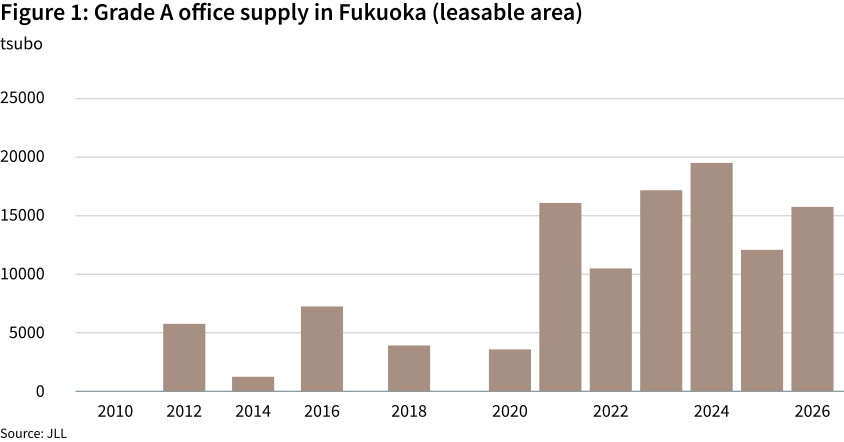
As large-scale redevelopment projects continue to expand the city’s Grade A office stock, attracting new occupier demand has become increasingly important (Figure1). Against this backdrop, fintech-related companies are beginning to attract attention as a sector capable of generating employment, investment, and long-term office demand. This report reviews occupancy trends of fintech-related firms in Grade A office buildings completed since 2020 and assesses their impact on the Fukuoka office market. To capture differences in office demand, tenant companies are classified into four groups based on their business functions (Figure2).
What Is Fintech : Fintech is an ecosystem rather than a standalone industry
Driven by advances in digital technology, fintech now encompasses a broad range of participants, including financial institutions, technology vendors, cloud service providers, and DX support firms. The interaction among these organizations forms a growing ecosystem that supports innovation across the financial sector.
Fintech Clustering in Fukuoka : Fintech demand is growing, but its market impact remains limited
Among 301 tenants in 13 Grade A office buildings completed since 2020 in Fukuoka, only 10 are fintech firms (3.3%). However, they occupy approximately 7,000 tsubo out of 79,000 tsubo total leasable area (8.9%), exceeding the wholesale and retail sector's footprint (6,000 tsubo), demonstrating fintech's growing demand presence.
While fintech clustering isn't yet large enough to drive overall market demand in Fukuoka, the sector continues expanding due to cashless payment growth, financial digitalization, and TEAM FUKUOKA's business attraction efforts. The following section examines fintech firms' composition and characteristics in Fukuoka and discusses further growth opportunities. (Figure3).
Geographic Distribution of Fintech-Related Firms : Distinct business functions are clustering in different parts of the city
Fintech-related occupiers exhibit a dual-cluster structure, with Tenjin attracting financial institutions, startups, and innovation-oriented firms, while Hakata serves as a hub for technology companies supporting financial systems and digital infrastructure. These complementary roles are helping shape Fukuoka’s emerging fintech ecosystem (Figure4).
Office Space Occupied by Fintech-Related Firms : The broader fintech ecosystem has become a meaningful source of office demand
Fintech-related occupiers collectively account for approximately 30% of the surveyed office space, highlighting their growing significance within Fukuoka’s Grade A market. However, much of the demand generated by pure fintech firms remains concentrated among a small number of major occupiers, particularly PayPay and PayPay Card.
Rent Levels : Fintech firms support demand for premium office buildings
Fintech-related firms tend to prioritize building quality, location, and workplace experience, resulting in occupancy within buildings that command rents above the market average. Their willingness to pay premium rents reinforces demand for newly developed high-grade office assets.
Headquarter Functions : Operational functions drive fintech clustering more than headquarters relocation
Most fintech-related firms in Fukuoka maintain development, systems management, sales, or support operations rather than regional headquarters. While this structure generates meaningful office demand and employment, attracting higher-level management and decision-making functions remains a longer-term challenge for the city.