Small Space, Big Impact: Designing the Indigenous Wellness Centre
Client story
Case Study - Unity Health Toronto – St. Michael’s Hospital
Categories:
Size:
650 square feet
Significance:
One of the first Indigenous wellness spaces within a Canadian hospital
When Unity Health Toronto began exploring the idea of creating an Indigenous Wellness Centre within St. Michael’s Hospital, the vision was clear: the space needed to be a place where First Nations, Métis, and Inuit patients and families could feel safe, cared for, and respected. It had to reflect Indigenous traditions while still meeting the complex technical requirements of a modern hospital environment. And it had to do all of this within a footprint of just 650 square feet within an older wing of the hospital.
The project became one of the first complete Indigenous wellness spaces within a Canadian hospital, setting a precedent for how healthcare facilities across the country might approach reconciliation through design. JLL Design was engaged as the lead designer and prime consultant, working alongside Unity Health’s Director of Indigenous Wellness Reconciliation and Partnerships; Unity Health’s Director of Capital Planning, Stasia Bogdan, and her team; and Indigenous design advisors Smoke Architecture, led by Eladia Smoke with Larissa Roque. Snyder Architects, led by Rochelle Moncarz, were responsible for technical and code review and permit drawings, while HH Angus Jeff Vernon and MEP Engineering provided mechanical expertise. The project was also supported throughout by many internal hospital teams and individuals. Together, this collaborative team showed how thoughtful, intentional design can turn even the smallest space into something transformative.
Intentional reconciliation in design
For JLL Design’s Workplace Design Advisory team, this project represented a shift in perspective. The team had been increasingly involved in projects where Indigenous perspectives were not only relevant but essential. In recent years, they had noticed that more and more clients were asking how to respectfully incorporate Indigenous knowledge into their work. For JLL Design, this meant not waiting for clients to raise the issue, but instead proactively asking how Indigeneity and Indigenous ways of knowing could shape the project.
In reflecting on the St. Michael’s project, the design team emphasized that the centre’s impact lies not in its size but in its intentionality. Despite its modest footprint and constrained infrastructure budget, the Wellness Centre has proven deeply meaningful for the community it serves. In their view, this demonstrates that reconciliation in design is less about scale or resources and more about the willingness to listen, respect traditions, and create spaces where people feel at home.
Collaboration at the core
The project’s strength lay in the partnerships that guided it. Unity Health’s Director of Indigenous Wellness, Reconciliation and Partnerships spearheaded the vision and acted as a bridge between community members and the design team. Smoke Architecture served as Indigenous design advisors, ensuring the space reflected the program’s intentions and the practices and traditions from First Nations, Métis, and Inuit communities without generalizing or privileging one group’s needs over another.
On the JLL Design side, Design Director Sara Dagovic led the design work day-to-day, translating community needs into practical solutions, while Susan Chang, Senior Vice President, provided executive oversight and helped position the project within JLL Design’s broader inclusive design strategy.
JLL Design’s role was not to prescribe, but to listen and facilitate. The Workplace Design Advisory team contributed expertise in space planning and healthcare design, with Snyder Architects providing the technical support to ensure compliance with code requirements and timely submissions. The real innovation came from balancing technical skills with humility: asking questions, moderating discussions, and creating room for multiple voices to be heard.
"Our role wasn’t to prescribe solutions, but to listen, to create space where Unity Health and Smoke could bring forward community perspectives, and then make sure those voices were heard and incorporated. That’s what made the collaboration so powerful."
Sara Dagovic
Design Director
Designing for culture and care
What emerged was a space that wove together cultural practices and modern healthcare needs in in a flexible and welcoming space. The design incorporated features such as:
Food and nourishment as wellness: Sharing meals is central to many Indigenous traditions. Community members emphasized the importance of preparing traditional foods, not just as nutrition but as a form of healing and teaching. The Centre therefore includes a kitchen designed to support communal food preparation and teaching, allowing food to play its role in cultural practice and care.
Smudging and ventilation: Smudging ceremonies, which involve the burning of sacred medicines, are vital to many Indigenous communities. To ensure these practices could be carried out safely within a hospital setting, the design incorporated a dedicated ventilation system to accommodate smudging without disrupting operations and is easy to use
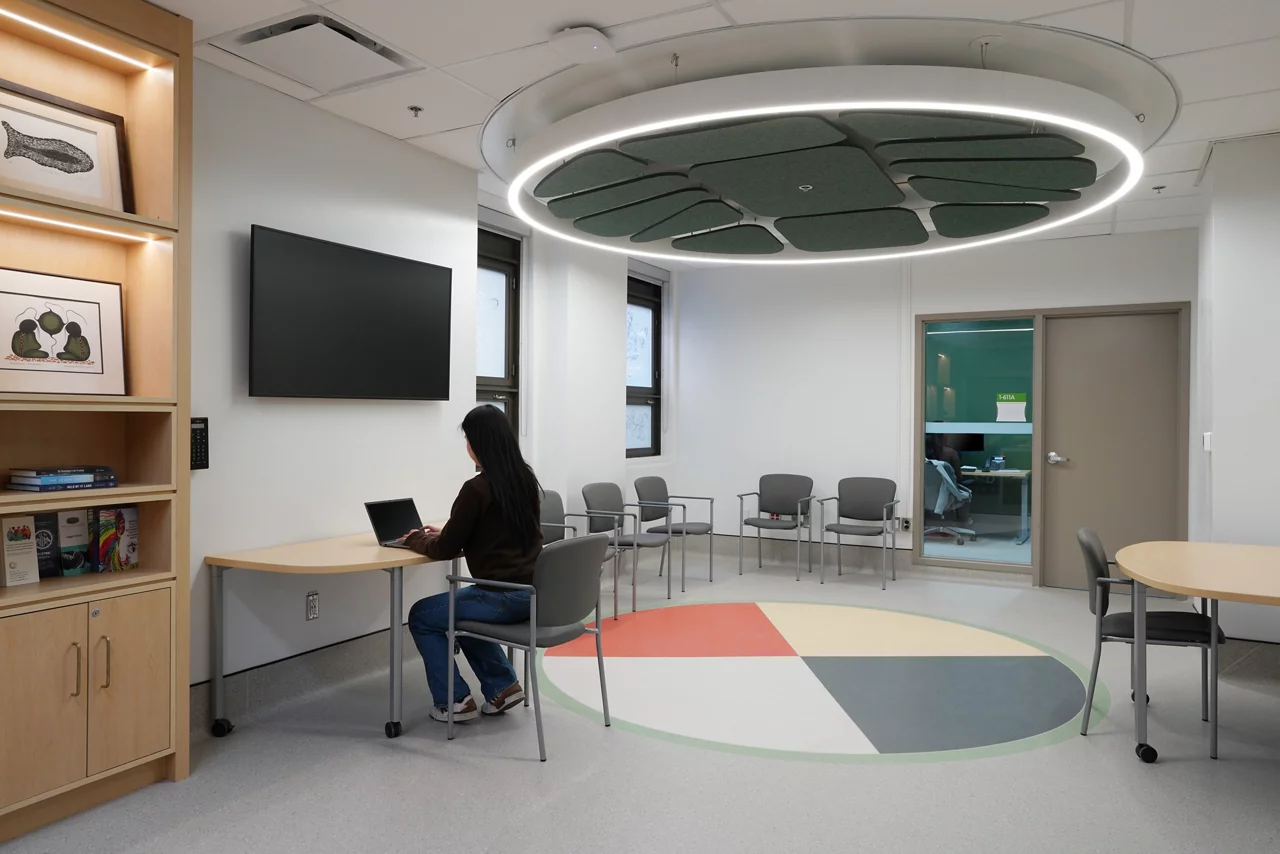
Orientation to the cardinal directions: For prayer and ceremony, alignment with the cardinal directions carries spiritual significance. The Centre’s floor and ceiling design incorporates markers that allow users to easily orient themselves, grounding the space in cultural meaning while maintaining a clean, functional aesthetic.
A holistic approach to wellness: Perhaps most importantly, the space reframed what it means to deliver healthcare. Instead of focusing solely on physical treatment, the Wellness Centre emphasizes emotional, spiritual, and community wellbeing. This holistic approach reflects a broader shift in Canadian healthcare toward whole-person care, as recognized in Statistics Canada research on comprehensive health models and in recent studies on embedding person-centred care cultures within Canadian healthcare systems. Here, it is expressed in ways specifically meaningful to Indigenous communities.

Photography Credit: Edward Zhao
Overcoming challenges
Designing such a space was not without its challenges. St. Michael’s Hospital is a heritage-designated building, which meant that any modifications required navigating layers of regulatory oversight. For example, the inclusion of a kitchen was initially met with resistance due to concerns about grease particulates and heritage preservation. The Planning team and Food Services worked closely with Unity Health to set the parameters for food preparation. MEP Engineering, led by HH Angus Jeff Vernon, the design team developed kitchen ventilation system that satisfied regulations while still ensuring the cultural needs of Indigenous communities were met. Smudging ceremonies presented a parallel challenge. Hospitals are typically fragrance-free and high air quality-regulated environments where smoke can easily trigger alarms. Here again, collaboration with mechanical engineers was essential: the design incorporated a dedicated ventilation system that made smudging possible in a safe and respectful way, without disrupting hospital operations.
The multi-faceted functions of gathering and education also needed to be accommodated in the small space. JLL and Smoke worked with Unity Health to select furniture that could be reconfigured in different ways to support the emerging programming, while also, being stored away to create an open area for ceremonies and different levels of mobility and sizes of gatherings.
Representation also posed its own set of challenges. With so many diverse Indigenous cultures to consider, it was essential not to generalize or privilege one group’s needs over another. Unity Health’s Director of Indigenous Wellness, Reconciliation and Partnership synthesized feedback from community members, while Smoke Architecture advocated for cultural integrity in the design. JLL Design’s role was to facilitate dialogue, moderate differing views, refine and blend furniture and finish selections and ensure every perspective was acknowledged and incorporated into the final space.
A model for reconciliation through design
The result is a statement: reconciliation in healthcare design does not depend on scale or grandeur, but on intention and respect. At 650 square feet, the Indigenous Wellness Centre is proof that even small spaces can carry immense meaning when they are created in partnership with the communities they serve.
For JLL Design, the project has had ripple effects beyond St. Michael’s. It has influenced how the design team approaches other projects across Canada, embedding Indigenous consultation and ways of knowing as a standard part of the design process.
In this sense, the Wellness Centre has become a model not only for culturally integrated healthcare, but also for inclusive, community-centred design more broadly.
"Traditionally, hospitals have been places you go when you are sick. This space is about wellness. It’s a place where people can feel safe, cared for, and respected. That’s what makes it so meaningful—not just for the community, but for us as designers too."
Susan Chang
Senior Vice President,
Workplace Design Advisory

Photography Credit: Edward Zhao
Conclusion
The Indigenous Wellness Centre at St. Michael’s Hospital demonstrates what is possible when design begins with listening and humility. It shows that reconciliation in design is not about size, prestige, or even budget. It is about intention: creating spaces where Indigenous communities see their traditions respected and their needs honoured.
For Unity Health, the centre provides a vital resource for Indigenous patients and families. For JLL Design, it represents leadership in inclusive design and a commitment to meaningful community engagement. And for the design industry as a whole, it sets a precedent: reconciliation is not optional. It is essential, and it begins with design that is small, intentional, and transformative.