Energy and resilience are reshaping leasing decisions in the industrial & logistics sector
18 February 2025
Insight
18 February 2025
Powering operational excellence
Categories:
Authors
Paulina Torres
Key Highlights
Market dynamics, power concerns, cost pressures and looming carbon reduction targets are pushing energy management and resilience to the forefront of leasing decisions in the industrial & logistics sector.
- Occupiers are prioritizing energy-smart buildings to drive operational excellence and cost efficiencies, impelled by concerns over power availability and surging energy prices in recent years.
- The sector faces heightened operational security threats from climate risk due to complex operations and a greater presence in areas more vulnerable to extreme weather events.
- Two-thirds of top industrial & logistics occupiers have commitments to reduce emissions, primarily through energy upgrades, fleet electrification and clean energy procurement.
- As inventory ages rapidly – with 76% of industrial stock over a decade old in the U.S., and 69% in Europe – retrofitting buildings emerges as a crucial strategy for owners to mitigate obsolescence risk, attract top tenants and enhance value.
The industrial & logistics real estate landscape is at a critical point
After several years of unprecedented growth, owners, investors and occupiers are strategically reassessing assets and location strategies ahead of the next market cycle. At the same time, power availability and security are emerging as top priorities for many occupiers in the sector. Increased automation, fleet electrification, the surge in advanced manufacturing, and competition with data centers for limited energy resources are collectively reshaping market dynamics. Occupiers are prioritizing cost efficiencies and seeking innovative ways to elevate business practices, and owners are pre-emptively evaluating methods to remain competitive. At the nexus of this market shift are increasingly complex energy markets paired with growing pressures to materialize on carbon reduction goals.
Occupiers have typically focused on technical requirements (e.g., ceiling height, loading docks, etc.), but as they prioritize operational excellence, requirements are becoming increasingly specific and standard warehouses are no longer fit-for-purpose. Spaces that deliver broader solutions, especially around energy management, resilience and broader sustainability, will gain competitive advantage in the coming years.
Additionally, advanced manufacturing - the use of innovative technology to improve products or processes – is a rapidly growing segment in the industrial sector. Companies involved in battery, electric vehicles (EVs), renewables and climate tech are emerging as significant drivers of this growth and are especially hungry for spaces that align with their core business of sustainability and decarbonization.
Building owners willing to leverage sustainability could capitalize on this shifting demand to create economic value, while keeping up with tightening regulations and evolving stakeholder expectations. A strategic pivot towards energy management, sustainable building practices and comprehensive tenant engagement can transform leasing dynamics, ensuring that industrial spaces are fit for the future.
To understand how sustainability commitments are impacting lease markets in the sector, JLL evaluated the leased footprint of major occupiers across 18 industrial & logistics hubs in North America, Europe and Australia, investigated publicly stated targets and relevant details and assessed current supply and construction pipelines.
Across the 900 occupiers researched in this study (representing 850 million square feet of leased space), we found that 65% of their future space needs will be tied to a carbon reduction target. In other words, nearly two out of every three future requirements for industrial space come from occupiers with established targets to reduce operational emissions, primarily through energy upgrades, fleet electrification and clean energy procurement.
Average lease terms are about seven years for industrial tenants, meaning that leases signed today will collide with 2030 targets to reduce emissions by 50%, an interim target that many of these occupiers have set. This will significantly impact their near-term leasing decisions, and many will need to re-evaluate their current spaces as they seek spaces aligned with their carbon reduction targets.
Tenant activities are typically responsible for 90% to 100% of operational carbon emissions in industrial buildings, compared to 55% to 75% in offices. This means that cooperation from tenants – especially in the form of co-investments – are particularly critical for successful decarbonization of the sector. In Australia, many landlords are already considering tenant screening processes and favoring tenants with lower operational carbon intensities as well as those willing to share data and collaborate on building performance improvements.
Low carbon supply will struggle to meet demand
Action to decarbonize real estate is lagging significantly and, despite improvements in energy efficiency in some sectors, emissions from buildings remain high and are still in fact rising. The industrial sector itself has especially lagged in decarbonization and energy efficiency improvements and, without increased levels of retrofitting, owners will face acute challenges to meet the increasing demand for sustainable space. Across the 18 hubs researched in this study, 41% of projected demand for low carbon space will not be met by 2030, given the current quality of existing stock and construction estimates over the remainder of the decade. This study only considers the largest occupiers, representing 30% of leased area across the markets covered; it inherently underestimates the total demand for low carbon assets - the broader market for such assets is far greater.
Supply-demand dynamics vary across industrial markets. More calibrated markets, like the UK and Sydney, show greater alignment between owners and tenants on decarbonization efforts, driven by regulatory pressures and carbon commitments. In these markets, owners who neglect carbon performance risk facing a ‘brown discount’ and greater challenges relating to liquidity when it comes to selling their properties. Conversely, imbalanced markets, such as Chicago and Belgium, characterized by energy-intensive outdated stock and limited clean energy availability, present unique challenges. For owners in these markets, acting promptly to improve a building’s energy performance can position them as market-leaders, enabling them to secure high-quality tenants and ensuring tenants don’t opt for other locations like build-to-suit sites.
Demand for low carbon space will vary by market and industry
Powering solutions
The industrial sector is uniquely positioned to scale energy and sustainability solutions that can drive real progress in decarbonizing the built environment, as well as operational security and economic value for both owners and occupiers.
Delivering energy solutions
Delivering resilience
Protecting value
Delivering energy solutions
Global energy demand is rising more rapidly than anticipated, raising significant concerns about energy security and pricing for businesses and people worldwide. Access to adequate power is already the top concern for many industrial occupiers as an increasing number of companies require high-capacity energy solutions. Moreover, energy prices have surged in recent years. Over the last five years, they have increased by 29% in the U.S., 71% across the European Union and 54% in the UK; while in Australia, year-over-year energy prices increased by 25% in 20241. In contrast to other asset types, industrial users are more vulnerable to fluctuations in energy costs due to their transportation-dependant and/or energy-intensive operations. As a result, many are turning to the spaces they use for solutions.
Electricity use has grown at twice the pace of overall energy demand in the last decade according to a recent report by the IEA, and while global energy demand is expected to increase by 5% by 2030, electricity demand is projected to increase by 18%. This trend is acutely evident within the industrial sector as a growing number of warehouses rely on automation, robotics and electric fleets.
Given soaring energy prices and the transition to an electric future, occupiers are prioritizing energy-smart buildings to drive operational excellence, energy security and cost efficiencies. Retrofitting buildings with features like LED lighting and solar panels can achieve energy cost reductions of 10-35%. For a 100,000 square foot building (9,290 square meters), our estimates show that this would amount to average annual savings of US$22,000 to US$78,000 for warehouse and distribution properties and US$67,000 to US$234,000 for manufacturing sites. In the face of heightened apprehension around power, onsite energy installations paired with battery storage systems are also emerging as critical solutions.
Delivering resilience
Given complex supply chains and operations as well as a greater presence in areas more vulnerable to extreme weather events, a warming climate presents acute challenges for the industrial & logistics sector. For example, across the U.S., 69% of industrial inventory sits in the top 10 markets most exposed to climate risk, compared to 57% for offices. In Europe, 49% of industrial inventory lies in the region’s 10 most exposed markets, compared to 42% for offices. Occupiers in this sector will increasingly look for properties that ensure business continuity and employee safety through enhanced physical resilience and onsite energy solutions.
Considering the increasing regulatory focus on energy and carbon, sustainable warehouses enable owners and occupiers to stay ahead of compliance requirements. Whether it's the evolving building performance standards adopted by 13 U.S. cities, with 30 more expected by 2026, or the European Union's Corporate Sustainability Reporting Directive (CSRD) with first reports due this year, warehouses that demonstrate enhanced energy and emissions performance will remain resilient against new regulations.
Protecting value
In recent years, the surge in e-commerce, accelerated by the pandemic, drove unprecedented development for industrial real estate, particularly for logistics and warehousing uses. An important distinction for the sector overall, compared to offices, is that shorter construction timelines have allowed developers to be more responsive to changing market demands. Yet, 2025 is beginning with little to no new construction across major markets globally as development levels stabilize.
At the same time, inventory is aging rapidly in most established industrial & logistics hubs. In the U.S., 76% of stock is over a decade old, compared to 69% in Europe and 75% in Australia. Although some buildings over 10 years are still considered high quality, much of this aging stock will require some form of improvement to maintain competitiveness. Moreover, the scarcity of developable land in many industrial markets across the world, coupled with constraints on new supply, reinforces the imperative for upgrading existing facilities. These factors collectively strengthen the case for retrofitting as a key value-add strategy in the industrial & logistics real estate sector.
It is also notable that sustainable practices in the sector influence more than solely environmental factors. For example, the warehouse industry experiences significantly higher employee turnover rates. Investing in sustainable building features that improve ventilation and indoor air quality, offer access to green spaces and comfortable temperatures and work environments can enhance employee retention for occupiers.
Navigating solutions
Sustainability and energy priorities within the industrial sector are more nuanced as uses vary significantly within this property type. Leading users within warehousing and distribution properties typically favor onsite energy, efficiency and EV infrastructure, while manufacturing companies tend to prioritize energy efficiency and security, as well as waste management. Generally, as occupiers understand what they need to do to show progress on sustainability commitments, building upgrades that allow owners to communicate measurable improvements are key differentiators. Already, there is a growing awareness around building energy and emissions performance, especially in Europe where CRREM (Carbon Risk Real Estate Monitor) is currently being reviewed for the sector. Furthermore, many industrial occupiers form part of their customers' Scope 3 emissions, creating additional pressure for these occupiers to decarbonize their own operations to meet the sustainability goals of their entire value chain.
Measurable targets:
Energy efficiency: A reduction in Energy Use Intensity (EUI)2 of 50-60% below current building averages, including net reductions achieved through onsite energy sources.
Embodied carbon: A reduction of embodied carbon3 by ~40%.
Clean energy produced onsite and EV charging infrastructure can generate additional revenue streams for owners. We’ve already seen many instances of industrial owners monetizing the income from such solutions through increased rent or direct-pay through structures like Energy as a Service (EaaS).
The case for solar
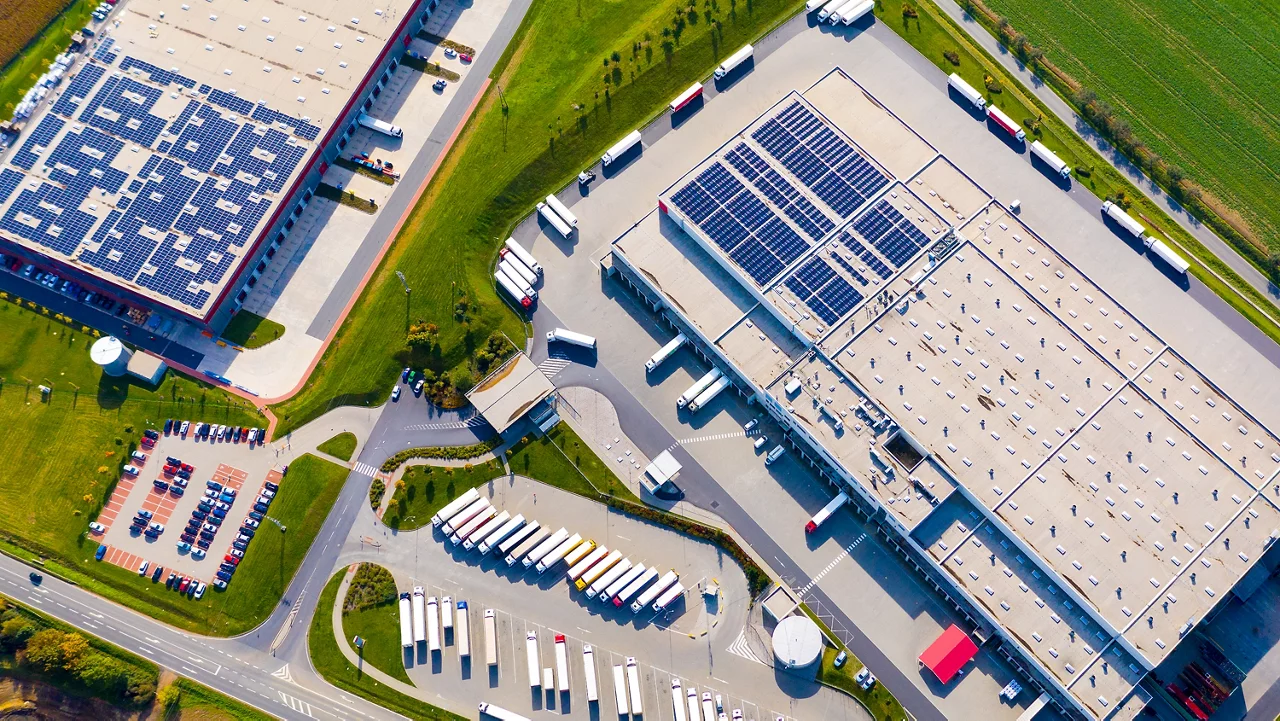
Industrial facilities, with their extensive flat rooftops, are ideally suited to harness significant amounts of energy from direct sunlight though onsite power. If fully utilized, industrial warehouses across the U.S. could produce, on average, 176% of their annual electricity needs. According to a 2022 study, only 5% of warehouses in the UK have rooftop solar, yet leveraging 18.5 million acres of unused warehouse rooftop space would more than double the country’s solar capacity. In the Netherlands, the adoption of onsite solar on warehouses is nearly standard practice for all new builds or where the construction of existing buildings allows. However, in most other industrial markets, deployment of onsite solar remains slow, presenting a substantial opportunity for sustainable energy expansion and cost reduction.
Historically, warehouse owners have hesitated to invest in rooftop solar systems due to high upfront costs and limited options to sell excess energy, especially when tenants don't fully utilize the generated power. However, a shift is underway, particularly among leading industrial property owners. Prologis, Brookfield and Lineage Logistics were named among the top 10 companies by installed onsite solar capacity in SEIA’s Solar Means Business 2024 report. As investors become more adept at navigating these complex structures, we anticipate a significant impact on property valuations.
The case for EV charging
Fleet electrification is emerging as a significant decarbonization lever for industrial occupiers. Collectively, the occupiers researched in this study alone will increase their EV fleet size sixfold, amounting to 16.6 million electric fleet vehicles on the road by 2030. As companies transition their fleets from fossil fuels to electric, they are shifting fuel expenses into real estate costs through the use of onsite charging infrastructure. This shift brings significant implications for site selection criteria and overall CRE strategies.
Our EV Solutions team has found that electrifying trucking fleets can typically save operators 20-25% of the total cost of operating those trucks (excluding labor). For context, trucking expenses represent 44% of a logistics company’s total costs, with approximately 30% allocated to labor and the remainder to energy (fuel), the purchase/lease of trucks and maintenance. This 20-25% cost reduction on fleet operations would usually translate to 6-8% savings in overall Profit and Loss (PnL) for logistics companies. Therefore, access to affordable and reliable energy for fleet electrification becomes a key competitive requirement – a requirement that is already impacting real estate decisions and site selection strategies today, especially among leading warehouse and logistics users.
This transition has substantial implications for power capacity at industrial sites, as properties will need to be prepared to support long-term fleet electrification efforts. This means not only installing EV charging stations but also ensuring that the site's electrical infrastructure can handle the increased power demand. For many existing facilities, this may require onsite energy solutions, significant upgrades to electrical systems and potentially working with local utilities to increase power capacity. Providing these solutions offers clear opportunities for owners to generate additional returns, especially through integrated EV and onsite energy and storage strategies.
Other sustainability advances include rainwater harvesting systems, which, while not yet widespread, are emerging as a frontier solution for industrial properties. They offer the capability to collect rainwater for onsite use, a solution that is particularly valuable for water-intensive operations such as cold storage facilities and advanced manufacturing sites.
Case study: Link Logistics’ Energy Solutions product
The "split incentive barrier" in real estate hinders decarbonization efforts across sectors, but particularly in industrial given the prevalence of triple-net lease structures. Under triple-net leases, tenants pay utilities, so landlords investing in energy improvements don't directly benefit from the savings. This discourages both parties from funding such upgrades, necessitating a new approach to align incentives and promote energy efficiency investments.
Link Logistics has developed a proprietary energy and utility management amenity where it aims to transfer the management of energy and utilities from selected tenants to Link Logistics’ in-house team of energy experts and deploy a ‘measure-reduce-offset’ approach to advancing decarbonization at scale for its properties and drive shared value for themselves and their tenants. By accessing the data necessary, Link Logistics is able to identify opportunities to improve energy efficiency and deliver measurable benefits to tenants, lowering operating costs while achieving an attractive return on investment.
Defining success: Since the program’s inception in 2023, more than 1,000 customers have enrolled. The firm has executed 106 million square feet of LED projects, reducing energy consumption at Link Logistics’ warehouses by 98,400 MWhs and carbon emissions by 43,453 metric tons - equivalent to the carbon sequestered by 43,586 acres of U.S forests in one year. This has translated to a total benefit of US$0.16 per square foot for enrolled customers, averaging 12% savings on utility bills.
Tenants in action
Top occupiers are integrating energy and sustainability priorities into their leasing decisions. As pressures regarding energy use and carbon commitments increase, this trend is set to expand rapidly in the coming years.
Implications for building owners and occupiers
Owners:
- Volatile energy markets present opportunities for owners to insulate tenants from rising costs as well as offer secure energy. Industrial spaces are uniquely equipped to provide such benefits.
- Owners and investors willing to innovate with sustainability can leverage changing market dynamics to position their properties as solutions-driven assets. Collaboration with tenants in energy and decarbonization efforts is crucial.
- Owners and investors who act quickly to upgrade assets and communicate measurable improvements in energy and carbon performance will thrive in the evolving landscape.
Occupiers:
- Industrial users are increasingly driven by power concerns as well as the need to translate sustainability commitments into tangible progress.
- Demand is moving from purely functional design requirements to spaces that can offer comprehensive solutions – especially regarding energy security, operational cost efficiencies and fleet electrification. But occupiers should be prepared to partner with owners to achieve such solutions.
- Beyond energy and environmental commitments, sustainable spaces can also enhance working conditions, (e.g., through elements that improve natural lighting, thermal comfort, indoor air quality and access to green space) significantly boosting employee retention.
True now more than ever, sustainability is integral to business fundamentals, driving a transformative shift that addresses some of today's most complex challenges. Industrial buildings present significant opportunities for both owners and occupiers to achieve sustainability goals and operational excellence. With advances in new technologies, increased automation and the electrification of transport, industrial properties are becoming active agents in daily operations. They can facilitate cost savings, offer secure energy, shield users from volatile energy markets, ensure compliance with evolving regulations and propel progress on sustainability commitments.
1Note, historical data extending a longer timespan was not accessible for the Australian market. Annual comparisons where attained here.
2Energy Use Intensity (EUI): a building's energy use as a function of its size (e.g., kBtu per sqft)
3Embodied carbon: the emissions generated during the construction of a building, as a function of its size (e.g., kgCO2/sqft)
Want to learn more?
Get in touch with our research team to find out how we can support your real estate sustainability strategy with market insights and strategic advice.